A burst line in a shop, a floor drain backing up in a kitchen, or no water on opening morning is a business problem as much as a plumbing one.
Our commercial plumbing service in Fayetteville, GA answers the same 24/7 dispatch line as our home work. While you wait, close the main shutoff, keep customers and staff away from wet floors, and move stock off the ground.
Commercial plumbing covers restaurants, retail units, offices and rental properties, along with the shared drains and supply lines that serve them. Some of it is urgent, like leaks and sewer backups. Some of it is planned, like grease trap cleaning and backflow testing. This page covers both, and it is honest about what each can and cannot do.
Water on the floor after hours: first moves for a business
A broken supply line, an overflowing restroom or a sewer backup in the middle of the night will not wait for opening hours. Our dispatch line is open 24/7, and same-day appointments are available when the schedule allows for problems that are stable. Describe what you see, where the shutoff is, and whether the building is occupied.
- Shut off the water at the main valve, and close the fixture valve if the leak is local.
- Turn off power to wet areas only if you can reach the panel without standing in water.
- Photograph the damage before you clean up, in case you need to file a claim.
- Block off slick floors and keep food areas clear if sewage has come up.
Do not use drain chemicals on a backup. They splash back on whoever works on the line, and they rarely clear a blockage that has already reached a floor drain.
Managing a rental or tenant space: who to call and what we need
Landlords and property managers often call on behalf of a tenant who is not on site. Give us the unit, a contact who can let us in, and any access rules. We will also ask whether the problem is inside one tenant space or in a shared line serving several.
For property managers and landlords
Tell us who authorizes the work and who pays. Lease terms differ on whether the owner or tenant is responsible, and we cannot settle that for you.
Ask for an itemized invoice with the unit named on it. That makes it easier to bill the right party later.
Commercial leak detection: what it finds and where it stops
Leak detection in a commercial building uses acoustic listening devices, thermal cameras, pressure tests and, in some cases, tracer gas. These methods narrow down a leak without tearing out walls, and they work best on pressurized supply lines. For more on the methods themselves, see our leak detection page.
The limits are real. A large building with many branches can hide several small leaks. Pump and HVAC noise can mask the sound of escaping water.
Leaks under thick slabs or in unmapped lines can take more than one visit to pin down. Detection tells you where to open up, not always what the repair will be. If a leak sits in a buried line under a slab, slab leak repair explains the options.
Grease trap cleaning: planned work that prevents emergencies
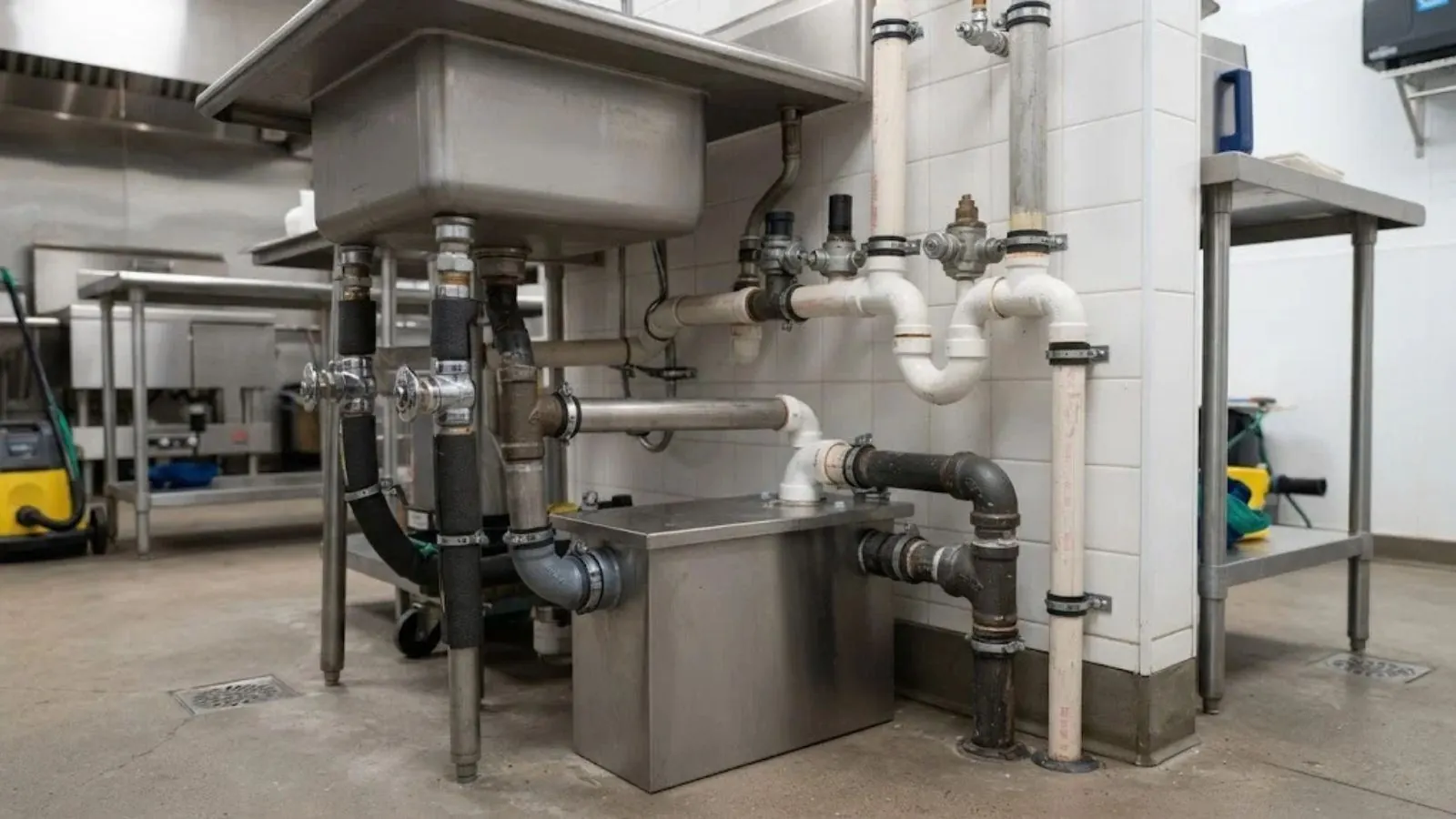
A grease trap catches fats, oils and food solids before they reach the sewer. When it fills, the trap stops working, odors build, and the drain behind it clogs. A backed-up kitchen floor drain on a busy night is usually the end result of a trap that was left too long.
Cleaning means pumping out the contents, scraping the walls and baffles, and checking that the inlet and outlet flow freely. Follow the manufacturer's guidance and any requirement from the local utility or your landlord on how often. Scheduling it ahead beats an emergency pump-out.
If the line beyond the trap is already coated, cleaning the trap alone will not stop repeat clogs. A jetting pass through the kitchen line can restore flow. See hydro jetting for how that works.
Backflow testing: a scheduled check on the water supply
A backflow preventer is a valve assembly that keeps used water from flowing backward into the public supply. Restaurants, irrigation systems and fire sprinkler lines often have them. Testing confirms the internal checks still seal.
Whether a test is required, and how often, depends on the device and the water utility's rules. Ask the water utility serving your address, and keep the test report on file. This is planned work, not an emergency call. A device that fails its test usually needs rebuilt parts or replacement, and the plumber will tell you which before work begins.
Floor drains, restrooms and kitchens: what typically goes wrong
| Problem | Likely cause | Typical response |
|---|---|---|
| Floor drain slow or backing up | Grease, debris or a blocked branch line | Cable or jet the drain, then check the line with a camera |
| Restroom toilet overflows often | Paper, wipes or a partial main blockage | Clear the line and review what is being flushed |
| Low pressure in one unit only | Partly closed valve or corroded branch line | Check shutoffs, then inspect the supply pipe |
| Sewer odor in the dining area | Dry trap or damaged drain vent | Refill traps and inspect the vent and drain |
| Repeated backups in several units | Problem in the shared sewer lateral | Camera inspection and main line cleaning |
For repeat backups, a camera shows whether the pipe is blocked, cracked or full of roots. Our sewer camera inspection page explains what the footage shows.
Units on Highway 85 and in shared retail centers
Fayetteville has commercial space along Highway 85 North, at Banks Crossing and around Fayette Pavilion. In a multi-tenant center, a single failing drain can affect neighboring units that share the same line. When you call, tell us whether the building is shared so we can look at the common line first and the tenant space second.
We serve commercial properties in ZIP codes 30214 and 30215. Remodels and new build-outs are separate planned work, and plumbing installation covers fixtures and rough-in. Permit rules vary, so ask the Fayetteville building department before any pipe rerouting.
How commercial jobs are priced
Price depends on the size and age of the system, how easy the line is to reach, whether the work must happen outside business hours, and what the job involves. We give you a clear price before work starts. Call (770) 214-4545 to describe your building.
Commercial property policies usually respond to sudden accidental damage, not to wear and tear or the repair of the failed part. Policies differ, so check yours.
Business plumbing down tonight?
Close the main shutoff, clear the floor, and call so dispatch can plan the visit.
Commercial Plumbing questions from Fayetteville homeowners
Yes. The dispatch line is open 24/7. Close the main shutoff, keep people clear of wet or contaminated floors, and call with the address and what you see. Same-day appointments are offered when available for problems that are stable.
Yes. Restaurant work often means floor drains, grease traps, dishwasher lines and restroom fixtures. Planned trap cleaning is easier on your schedule than an emergency one.
No. Noise, hidden lines and many branches can make it harder, and some leaks take more than one visit. We will say honestly what the methods can and cannot find.
Ask the water utility that serves your address whether a test is needed and on what schedule. We can then book the test as planned work.
Whoever holds authority under your lease. Tell us who approves and who pays when you call, and we will address the invoice accordingly.
System size, access, the time of day, the materials involved and the work itself. We state the price before work starts.
Yes. For home drains see drain cleaning, and for main lines see sewer line cleaning.
Sources and standards. Backflow testing and grease trap rules are set by the local water utility and sewer authority, so ask them for their current requirements. Plumbing work follows Georgia's plumbing code, which is based on the International Plumbing Code (IPC).