
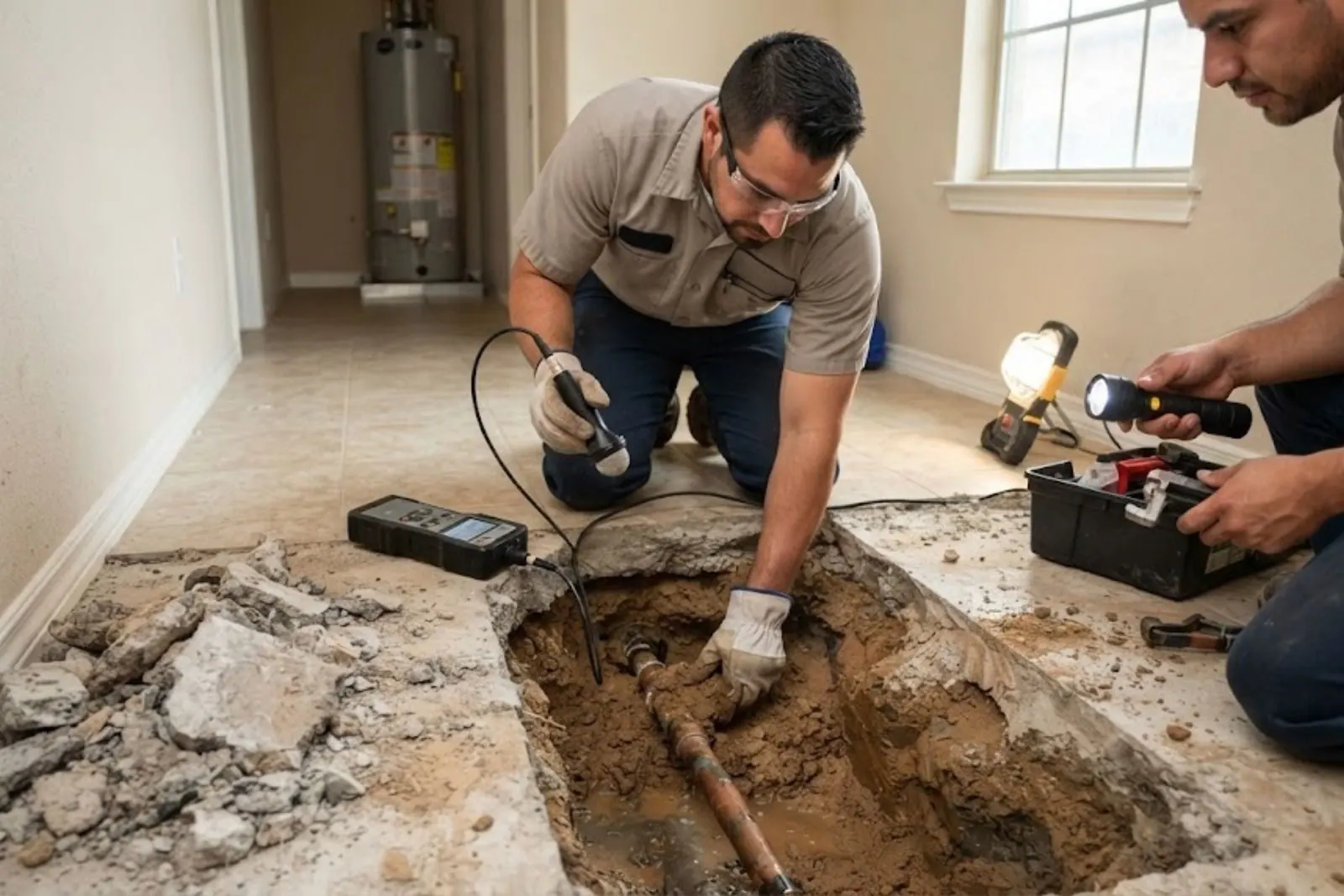
A slab leak is a break in a water line that runs under or inside the concrete floor of your home.
In Fayetteville, GA it often shows up as a warm patch on the floor or the sound of water with nothing running. The line is open 24/7. While you wait, close the main shutoff, stay off wet flooring near outlets, and do not run the water heater.
The pipe cannot be seen, so the first job is proving where it is and what failed. The second is choosing a fix that fits the house. This page walks through the signs, the three repair routes and the limits of each.
Warm floor spots, hissing and a meter that will not rest
Slab leaks are described in everyday terms before anyone uses the word. A spot on the tile that feels warm underfoot, carpet that is damp along one wall, a faint hiss in a quiet house or a water bill that jumped without explanation are the usual stories.
- Warm floor area: a hot water line leaking into the concrete and heating it.
- Damp carpet or lifting laminate: moisture working up from below.
- Meter spinning with all taps off: water is leaving the system somewhere.
- Low hot water pressure: a supply line losing flow before it reaches the fixtures.
- Cracks in grout or baseboards that were not there last season: slab movement, sometimes from soaked soil.
None of these proves a slab leak alone. A technician confirms it with a pressure test and listening equipment before anyone talks about opening a floor.
Water coming up under the floorboards
Water rising through flooring or pooling at the edge of a room is an emergency, at any hour. Shut off the main valve first, then switch off the water heater so it does not run dry. Turn off power to the affected room at the breaker panel only if you can reach it without stepping in water.
Pull up rugs, lift furniture legs onto blocks and photograph the damage for your insurer. Same-day appointments are available when the schedule allows, and the 24/7 dispatch line will tell you what to do while you wait. A weekend slab leak is no less urgent than a weekday one, because water under a floor keeps working on the wood and subfloor.
Spot repair, reroute or repipe: three ways to fix a pipe under concrete
| Option | Best for | Trade-off |
|---|---|---|
| Spot repair through the slab | One clear leak in a line that is otherwise sound | Breaks into the floor, and other weak spots may fail later |
| Reroute through walls or attic | Leaky lines that are hard to reach under flooring | Opens walls and ceilings, but leaves the slab alone |
| Repipe the affected lines | Pipes with repeated failures or visible wear | Highest scope, most lasting result |
The right pick depends on what the leak tells you about the pipe. One pinhole in an otherwise healthy line often suits a spot repair. Several leaks in the same loop usually mean the material is wearing out, and a reroute or repiping avoids digging up the same floor twice.
What the technician confirms before any floor is opened
Interview and isolate
The plumber learns when you noticed signs and shuts off individual fixtures to rule out simple causes.
Pressure test the lines
Each hot and cold line is tested separately to see which one loses pressure.
Listen and trace
Acoustic equipment and thermal imaging narrow the leak to a small area of floor.
Agree on the plan
You get the options in plain terms, and a price before work starts.
For a wider look at how hidden leaks are found, see leak detection. A slab leak search is the same toolkit applied to a floor.
Clay soil, newer slabs and what that means for your home
Fayetteville sits on Piedmont clay, which swells when wet and shrinks when dry. Slabs and the pipes under them can shift a little over the seasons.
Much of the local housing stock grew up in the 1990s and 2000s, so many homes are old enough for pipes to start wearing out. If your house is in that age bracket, ask the plumber about the condition of the other lines, not just the leaking one.
Plumbing under slabs for homes in 30214 and 30215 is the same work in either ZIP code. What changes is the age and material of the pipe, which the plumber identifies on site.
Honest limits of a slab leak repair
No repair removes the risk of a second leak from a pipe that is wearing out everywhere. A spot repair fixes one hole. If the surrounding copper is thin, another pinhole can follow in a few months. Tunneling under the slab keeps floors intact but is not always possible, and some floor finishes cannot be matched after cutting. A fair plumber will say so before starting.
Floor coverings, cabinets and moisture damage are separate from the plumbing. Ask who handles patching the concrete and restoring the finish, since that step is often not part of the plumbing quote.
Who pays: cost factors and insurance for slab leaks
Cost depends on the repair route, how deep and accessible the pipe is, the floor finish above it, and how much restoration follows. A quote should itemize detection, repair and any permit. Permit rules vary, so ask the Fayetteville building department before pipe rerouting. For pricing on your own floor plan, call (770) 214-4545.
Homeowners policies generally respond to sudden accidental damage, not wear and tear, and they often exclude the repair of the failed pipe itself. Some policies cover the cost of accessing the leak. Policies differ, so check yours and report the loss early.
Water under your floor tonight?
Dispatch can send a plumber who tests the lines before any slab is touched.
Slab Leak Repair questions from Fayetteville homeowners
A warm patch that stays warm with the heating off, plus a meter that moves with taps closed, strongly suggests a hot water line leak. Only a pressure test and listening equipment can confirm it. Do not cut the floor yourself.
Yes. Dispatch is open 24/7 and same-day appointments are available when the schedule allows. Close the main shutoff, turn off the water heater and call (770) 214-4545 while you wait.
Sometimes, with the main valve closed and water turned on only when needed. Wet flooring near outlets is a hazard, so the plumber will tell you what is safe. A leak that is spreading calls for a faster decision.
The repair route, the depth and location of the pipe, the floor finish and how much restoration is needed. A good quote itemizes each piece. Call (770) 214-4545 for a clear price before work begins.
Not always. A reroute through the walls or attic avoids the slab altogether, and some repairs can be done by tunneling under it. If breaking the slab is the best option, the plumber should explain why.
They overlap, but a slab leak sits under the floor and is often slow. A burst pipe is a sudden break in an open wall or ceiling, covered under burst pipe repair. Both need the main shut off fast.
Not necessarily. One leak in a healthy line is a spot repair. Repeated leaks or pipe that looks worn can justify a larger fix. The plumber should show you the reason for any bigger scope.
Sources and standards. Repairs that reroute or replace supply pipe follow Georgia's plumbing code, which is based on the International Plumbing Code (IPC). Pipe and fittings that touch drinking water should carry NSF/ANSI 61 certification, a standard for drinking water system components.