
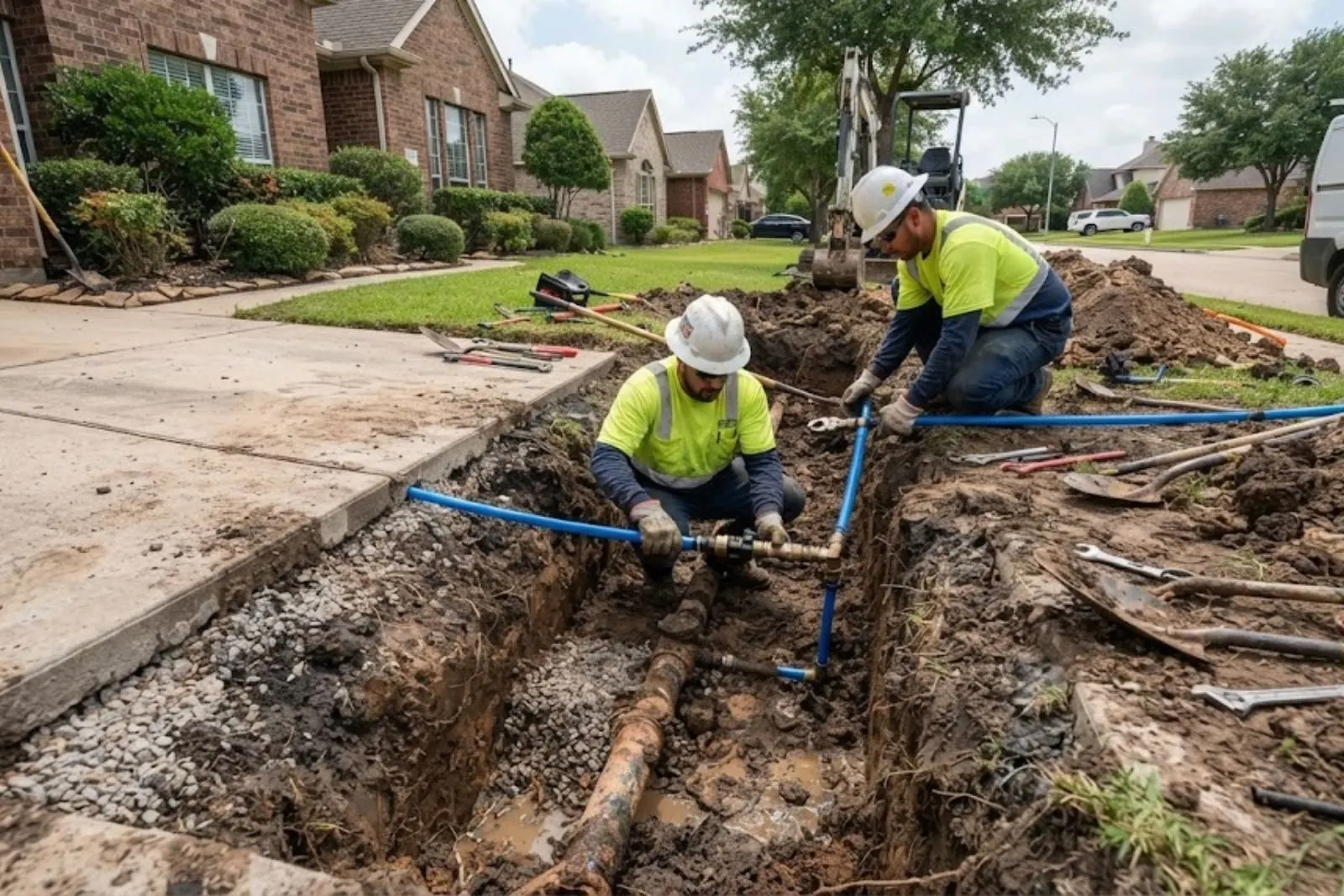
Your water service line is the buried pipe that carries water from the meter to your house, and when it breaks, the signs show up in the yard, at the meter or at the tap.
Water service line repair in Fayetteville, GA is available around the clock through our 24/7 dispatch line. If water is pooling near the meter or the house, close the main valve and keep people and pets away from the soft ground.
Low pressure, a soggy patch of lawn and a bill that will not stop climbing often trace back to this one pipe. The sections below separate the causes, explain spot repair versus replacement and describe how a line gets fixed without wrecking the yard.
Weak pressure all over the house
Low pressure that affects every fixture points toward the supply side, not a single clogged faucet. If only one tap is weak, look at its aerator first. If the shower, the kitchen and the hose bib are all weak, check the items below.
| What you notice | Likely cause | First check |
|---|---|---|
| Every tap weak, meter calm | Partly closed valve or a corroded line | Make sure the main and meter valves are fully open |
| Every tap weak, meter moving | Leak in the buried line | Look for wet ground between meter and house |
| Weak hot water only | Water heater or hot line issue | Compare hot and cold at the same faucet |
| Pressure drops at certain times | Shared supply demand or a failing regulator | Note the times and tell the plumber |
A pressure regulator that is worn out can also cause swings, so it is worth testing before anyone digs. The plumber attaches a gauge to a hose bib to see the actual number. If the pressure loss is inside the house, a line under the floor may be to blame, which is a slab leak question.
A wet patch between the meter and the house
Water that surfaces in the yard, floods a meter box or runs along a driveway edge can mean the service line has broken. Close the main valve at the house, then check the meter.
If the meter still moves, the leak is on the buried line and the water is still flowing, day or night. Call the 24/7 line rather than waiting for morning, since soil washes away around the pipe and the hole grows.
Do not dig yourself. Buried gas, electric and communication lines may share the same corridor. Keep children and pets off the soft ground and take a few photos of the wet area.
- Soft, sunken or unusually green ground in a line from meter to house.
- A meter box that fills with water even in dry weather.
- Sound of rushing water near the meter with fixtures off.
- A sudden jump in the water bill with no change in use.
Spot repair or full line replacement
A single break in a pipe that is otherwise sound is a spot repair. The plumber exposes the damaged section, cuts it out and joins in new pipe with proper fittings. This is the cheaper and faster route when the rest of the line is in good shape.
Replacement makes sense when the pipe is old, repeatedly leaking, crushed, or made of a material that is wearing out along its whole length. A repair that fails again in a few months costs more in total.
This is usually a replacement job, not a repair, when the second or third leak appears on the same line. The plumber should show you the removed pipe and explain why a longer run needs replacing.
Trenchless methods versus an open trench
An open trench is the straightforward approach: dig along the line, replace the pipe and backfill. It lets the plumber see everything and works almost anywhere, but it disturbs landscaping, driveways and walkways.
Trenchless methods use small access pits at each end instead of a full-length trench. They suit lines that run under concrete, mature trees or a finished driveway. Not every property qualifies, since the soil, the existing pipe and the line length all matter.
Piedmont clay is heavy and can compact around a pipe, so the plumber checks the ground before choosing a method. If you plan a landscape project, tell the plumber so the new line avoids it.
Call 811 before anyone digs
In Georgia, digging for a water line calls for a call to 811 first, so buried utilities get marked. The marks matter even for a short trench. Hitting a gas or power line is far costlier than waiting for the markers.
A homeowner does not have to arrange this alone. Ask the plumber who will call and how long the marking usually takes. Also ask the water utility which part of the line, from the street to the meter, is its responsibility, since that affects who repairs a leak there. Homes in 30214 and 30215 on city water should confirm this before any work starts.
Know your two shutoff valves
Most homes have a valve at the meter and another where the line enters the house. The house valve is the one you should use. The meter valve belongs to the utility, so avoid turning it unless the plumber says to.
Test the house valve once a year by turning it closed and open. A valve that is stuck or leaks around the stem can fail when you need it.
If it does not seal, replacing it is a small job and well worth doing before an emergency. If the leak turns out to be inside the house, leak detection can trace it. A sudden pipe split is covered in burst pipe repair.
What shapes the cost of a service line repair
Cost depends on the length of pipe, the depth, the soil, what sits on top of the line (lawn, concrete, roots), the repair method and whether it is after hours. Restoring the surface is a separate item. A good quote itemizes excavation, pipe, labor and backfill.
Homeowners policies generally respond to sudden accidental damage, not wear and tear or the repair of the failed line, and policies differ, so check yours. To talk through your yard and get a clear price, call (770) 214-4545.
Water coming up in the yard?
Close the house main and call dispatch so the plumber can plan the dig and the 811 marking.
Water Line Repair questions from Fayetteville homeowners
Yes. Dispatch is open 24/7, and same-day appointments are available when the schedule allows. Close the main valve at the house, leave the meter valve alone and call (770) 214-4545 while you wait.
Turn off the house main and watch the meter. If it keeps moving, the leak is between the meter and the house. If it stops, the leak is inside.
It depends on where the water utility's responsibility ends, which is usually at or near the meter. Ask the utility directly before assuming. The plumber can then repair only what falls to you.
An open trench disturbs a strip of ground. Trenchless methods keep the damage to small pits, though they do not suit every property. The plumber will explain which fits yours.
Length, depth, soil, surface cover, the method and the hour. Surface restoration is often separate. Call (770) 214-4545 for a clear price before work starts.
Check the aerators and the main valve first, then have a gauge put on a hose bib. A hidden leak, a worn regulator or a corroded line can all cause it.
Sources and standards. Call 811, the national call-before-you-dig line, before any digging. Service line pipe should meet NSF/ANSI 61 and the Georgia plumbing code, which is based on the International Plumbing Code (IPC).