
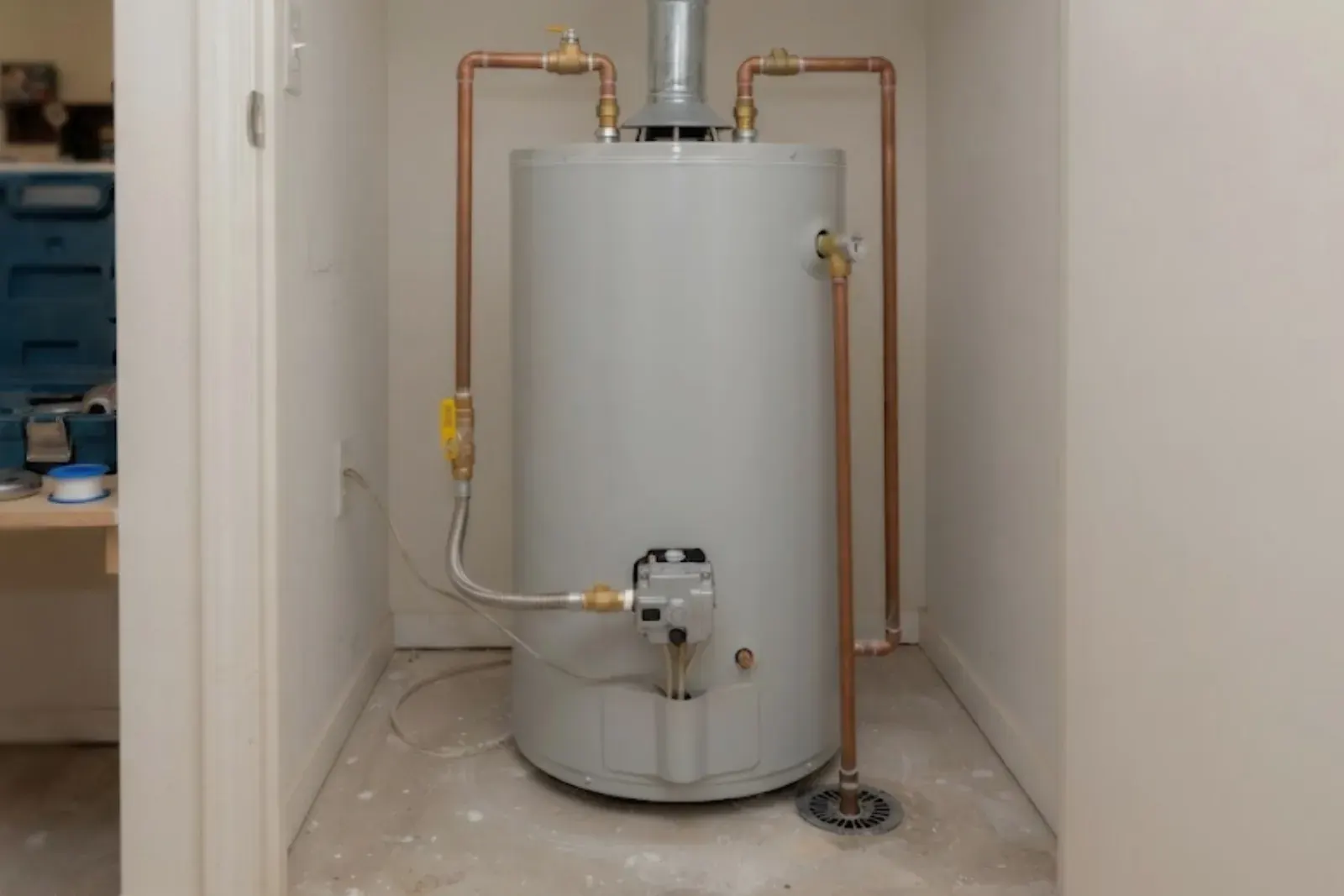
When a tank splits open at the base or the water has run cold for good, the question stops being how to fix it and becomes how fast you can get a new one in. The Fayetteville 24/7 Plumbing line is open around the clock, and while you wait you can close the cold valve above the tank and cut its power or gas control.
Water heater replacement in Fayetteville, GA is the removal of a failed or worn-out heater and the fitting of a new one, with the connections, venting, and safety devices brought up to a sound standard. This page covers how to judge whether a tank is finished, what the new unit could be, and what the visit involves.
Where the repair-or-replace line falls
| What the plumber finds | What it suggests | Usual direction |
|---|---|---|
| Water seeping from the tank body or seam | The steel inside has rusted through | Replace the unit |
| Heater is well into its second decade of service | Tank walls thin and sediment is heavy | Replace, even if it still heats |
| A single failed element or thermostat on a younger tank | The tank itself is probably sound | Repair |
| Several repairs in a short stretch | Parts are failing one after another | Replace |
| Rust-colored hot water with a corroded anode rod | Lining is breaking down | Replace if the rod is already gone |
No single rule fits every house. The plumber looks at age, leak location, and repair history together. If a fix is still sensible, you will hear that, and our repair service covers it.
Water spreading around a dead tank
A failed tank can release dozens of gallons before anyone notices, so the first ten minutes count. Close the cold valve on the supply pipe, switch off the breaker or turn the gas control to off, and open a hot tap somewhere to relieve pressure. Never touch a wet electrical connection.
While you wait for the plumber
Lift valuables and cardboard off the floor and use towels to guide water toward a floor drain. Photograph the unit, its label, and any damage before cleanup begins.
Those photos help later with an insurance claim and let the technician see the model before arriving. A night or weekend call goes to the same 24/7 dispatch line, and same-day appointments are offered when available.
What age and sediment do to a tank
Inside a steel tank, an anode rod sacrifices itself to slow rust. Once it is used up, corrosion goes after the tank wall. Meanwhile minerals settle on the bottom, insulate the water from the burner or lower element, and make the tank work harder.
How fast that happens depends on the water. Fayetteville's water comes about half from three city wells and the rest from the Fayette County Water System, and neither published report gives a hardness figure. Test your tap, or ask the water utility for its annual water quality report, before choosing a model that depends on clean water.
Many Fayetteville homes went up in the 1990s and 2000s, which means plenty of original heaters have already outlived a typical tank. If yours has a date on the label from that era, expect replacement to come up soon, planned or not.
Choosing the next heater: tank, tankless, or heat pump
| Option | Best for | Trade-off |
|---|---|---|
| Standard tank, gas or electric | A fast swap that reuses existing connections | Limited hot water supply and a finite tank life |
| Tankless | Households that want endless hot water in less space | Higher upfront work and regular descaling |
| Heat pump (hybrid) tank | Lower running cost when there is room and air flow | Taller unit, needs a drain, and runs slower on recovery |
A like-for-like swap is the quickest path after a failure. Changing fuel type, moving the heater, or going tankless involves extra work, and the installation page explains those projects. For the tankless route in particular, see the tankless unit page.
Sizing the new heater to how you use hot water
A heater that is too small runs out mid-shower. One that is too large wastes energy keeping extra water hot. Size depends on the number of people, how many bathrooms run at once, and whether you have a soaking tub or a large shower.
Tell the plumber what happened with your old unit. If you kept running out, a bigger tank or a different type may fit better. If hot water was always plenty, matching the old capacity is usually fine.
The replacement visit from shutoff to hot taps
- Drain and disconnect: the old tank is emptied and detached from water, gas or power, and venting.
- New connections: fresh supply lines, a shutoff valve, and a relief valve with a discharge pipe routed safely.
- Expansion control: an expansion tank is added where the plumbing calls for one.
- Venting and gas check: gas units get their vent and connections checked and tested for leaks.
- Startup and removal: the unit is filled, purged of air, brought to temperature, and the old tank is hauled off.
Permit rules vary, so ask the Fayetteville building department before a water heater swap. The plumber can tell you what the job involves. Homes across 30214 and 30215, the Fayetteville ZIP codes this work covers, follow the same city process.
What shapes the quote, and what insurance does
Cost depends on tank size, fuel type, the model you pick, venting changes, code updates to old connections, and how hard the heater is to reach. A good quote itemizes the unit, labor, parts, and haul-away. Ask what is included before work starts.
Homeowners insurance generally responds to sudden accidental damage, like a burst tank flooding a room, but not to wear and tear or the failed heater itself. Policies differ, so read yours. To get a price for your house, call (770) 214-4545.
Ready to retire a failed or aging tank?
Call the 24/7 line and a licensed plumber can walk through the right replacement for your home.
Water Heater Replacement questions from Fayetteville homeowners
Water coming from the tank body, rusty hot water paired with a worn-out anode rod, or a unit well past its expected life all point toward replacement. A single bad element on a younger tank usually points toward repair.
Yes. Dispatch runs 24/7. Close the cold valve, cut power or the gas control, and protect the floor. Same-day installs are offered when available, depending on the unit you need and what is on hand.
Often yes, but it is more than a swap. Tankless units can need larger gas lines, different venting, or electrical upgrades. If you need hot water fast, a tank may go in first, and a conversion can wait.
It can be, if the heater sits in a space with enough room and air, and a drain is nearby. They are taller and recover slowly in heavy use. The plumber can look at your closet or garage and say.
The unit type and size, fuel, venting, updates needed for current connections, access to the heater, and haul-away. Ask for the line items. Call for a price tied to your house.
Permit rules vary, so ask the Fayetteville building department before a water heater swap. Georgia plumbers can also be checked through the Secretary of State licensee search before you hire.
Removal and haul-away are part of a standard replacement visit. Confirm that it appears in the quote so nothing surprises you.
Sources and standards. A replacement follows the new unit's manufacturer instructions and Georgia's plumbing code, which is based on the International Plumbing Code (IPC), including its relief valve requirement. Gas piping falls under the National Fuel Gas Code (NFPA 54).