Sewer line repair in Fayetteville, GA fixes the pipe that carries waste from your house to the city sewer when it has cracked, shifted, filled with roots, or collapsed.
If sewage is backing up right now, the Fayetteville 24/7 Plumbing line is open day and night. Stop using water, keep everyone out of the wet area, and wait for the technician rather than trying to flush the problem away.
A repair is different from cleaning. Cleaning and hydro jetting remove what is in the pipe. Repair fixes the pipe itself, and the right method depends on what the camera shows.
Sewage in the house or a yard that smells like a drain
Raw sewage in a tub, shower, or floor drain is the loudest sign of a broken or fully blocked line. A wet, soft patch of lawn over the pipe path, with a sewer smell, points the same way. Water used in the house is going into the soil or back into the house, and every extra load of laundry adds to it.
Shut off water use, keep children and pets out, and call call (770) 214-4545. Tell dispatch whether it is inside, outside, or both. After-hours calls get the same dispatch line, and the first job is often to stop the overflow with a main-line cleaning pass so the camera can see the damage.
How a sewer line fails
Most failures are slow. Roots push into a joint, the gap widens, and soil washes into the pipe. Clay-rich Piedmont soil also swells and shrinks, which can pull a joint out of line or let a section sag. The table shows common failures and what they usually call for.
| Failure | What causes it | Usual response |
|---|---|---|
| Root intrusion at a joint | Roots chase moisture through a small gap | Jet out roots, then line or replace that section |
| Belly or sag | Soil settled or washed out under the pipe | Excavate and regrade the section |
| Crack or broken pipe | Ground movement, load, or age | Spot repair, lining, or replacement |
| Collapse | Corrosion or crushing of a weak pipe | Excavation and replacement of the section |
| Offset joint | Soil shift between two pipe ends | Joint repair or short replacement |
Clues that point to the pipe instead of a clog
- Repeat backups: a cable clears it and the drain fails again within weeks.
- Gurgling in the lowest drain: the toilet or tub bubbles when you use another fixture.
- A green, soggy spot in the yard: sewage water feeds the grass over a leak.
- A sewer odor outside: the smell comes from the ground, not just a drain.
- A sunken strip in the lawn: soil is washing into a break and leaving a void.
One of these alone may not mean much. Two or three together make a camera look worth the visit. A sewer camera inspection shows the pipe condition and the distance to each problem, so the repair is planned from footage, not a guess.
Spot repair, lining, or digging up the section
A spot repair removes and replaces one short damaged length. It suits a single crack or joint when the rest of the pipe is sound. It does need excavation at that spot, though usually a small one.
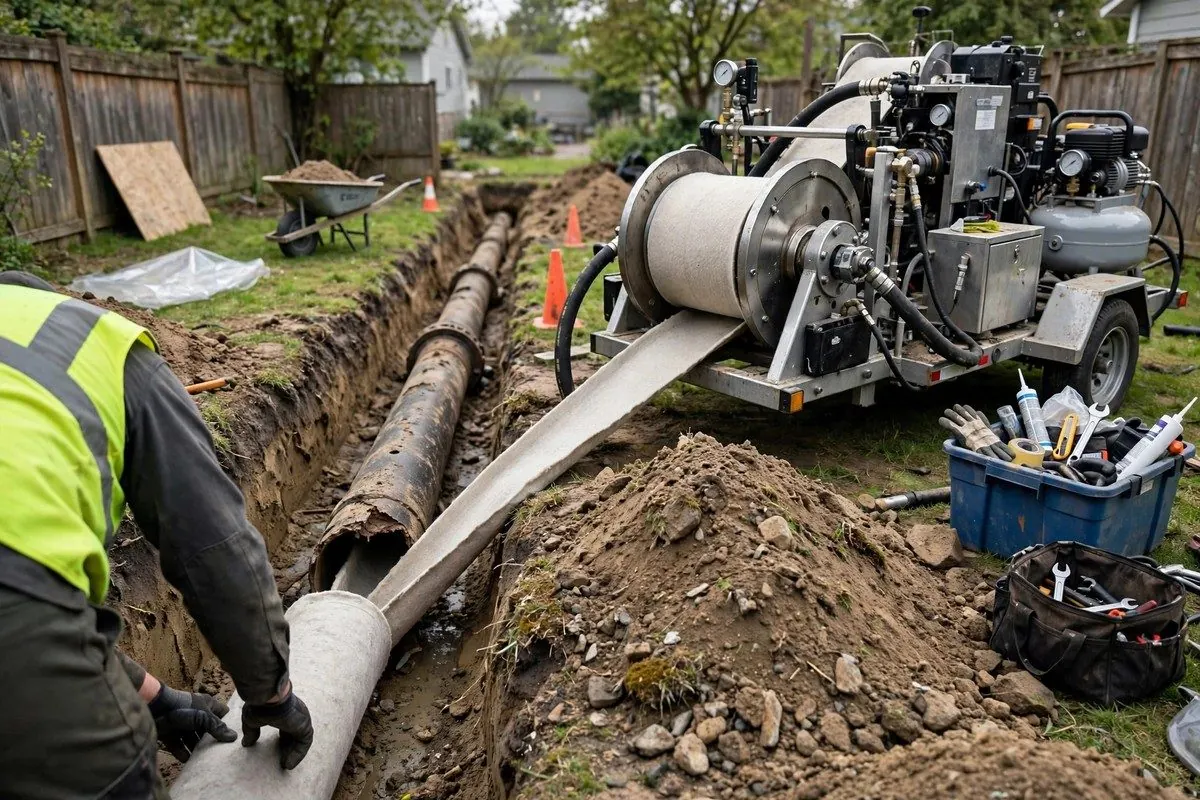
Trenchless lining pulls a resin sleeve through the old pipe and cures it into a new inner wall. It limits digging to access holes and can save landscaping and driveways.
It works only where the pipe is round enough and open enough to receive the liner, so a collapsed section still has to be dug. Full excavation replaces the pipe along the trench and is often the right call for a belly, a collapse, or severe damage.
Honest limits matter here. A sagging pipe cannot be lined to fix the sag, and a broken pipe is a replacement job, not a patch. A plumber should explain which option fits what the footage shows.
Older cast iron pipe
Cast iron was a common sewer and drain material in older houses. It rusts from the inside, flakes, and eventually thins until it cracks or crumbles. Much of the housing around Fayetteville grew up in the 1990s and 2000s, so cast iron is less likely there than plastic pipe, but a camera tells you what you actually have.
Cast iron that is scaled and thin is usually replaced, not patched, because new repairs fail where the old pipe is weak. If only a short stretch is bad, a section swap with proper couplings may work.
City sewer, not a septic tank
Fayetteville is on city sewer. The City of Fayetteville Water and Sewerage Authority serves the system, so your line runs to a public main, not to a septic tank. The pipe on your property is yours to maintain.
The main in the street is not, so the plumber will tell you which side of the tap-in a problem sits on. In the 30214 and 30215 ZIP codes, that boundary decides who calls whom.
Before anyone digs: 811, permits, price, and insurance
Call 811 before digging so buried utilities are marked. Permit rules vary, so ask the Fayetteville building department before pipe rerouting or replacement. You can also verify any plumber through the Licensee Search on the Georgia Secretary of State site, which covers the state plumbing boards.
Price depends on pipe depth, length, access, the method, driveways or trees in the way, and any permit costs. A good quote lists the method, the footage, and what restoration is included. Homeowners policies generally respond to sudden accidental damage, not to wear, root intrusion, or the repair of the failed pipe itself, and policies differ, so check yours. For a repair plan, call (770) 214-4545.
Broken pipe under the yard?
Call dispatch at any hour to get the line inspected and a repair method named.
Sewer Line Repair questions from Fayetteville homeowners
Yes. The (770) 214-4545 dispatch line is open 24/7. Stop water use, keep people out of the wet area, and tell dispatch whether sewage is inside, outside, or both. The first visit often clears the line so the damage can be inspected.
Sometimes. Trenchless lining uses small access holes and works when the pipe is open and round enough. A collapsed or sagging section generally still needs digging.
The line on your property up to the tap at the public main is generally yours. The main under the street belongs to the sewer authority. Ask the plumber to find where the problem sits, and contact the authority if it is the public side.
A wet, foul-smelling patch in the yard can mean an active leak. It is less urgent than a house backup but it should not wait long, because it can wash soil from around the pipe.
A sound, sealed joint or a lined section keeps roots out far better than an old open joint does. Roots can still find another weak spot, so ask about the rest of the line.
It depends on the policy and cause. Many policies respond to sudden accidental damage but not to wear or root growth. Read your policy or ask your insurer before work starts.
Depth, length, access, the repair method, what sits on top of the pipe such as concrete or trees, and whether permits are needed. A good quote itemizes each of these and states the restoration. Call (770) 214-4545 to talk through your line.
Sources and standards. Lining work is described in ASTM F1216, the standard practice for rehabilitating a pipe with a resin-impregnated tube, and defects on camera are commonly coded under NASSCO guidelines. Call 811 before any digging.