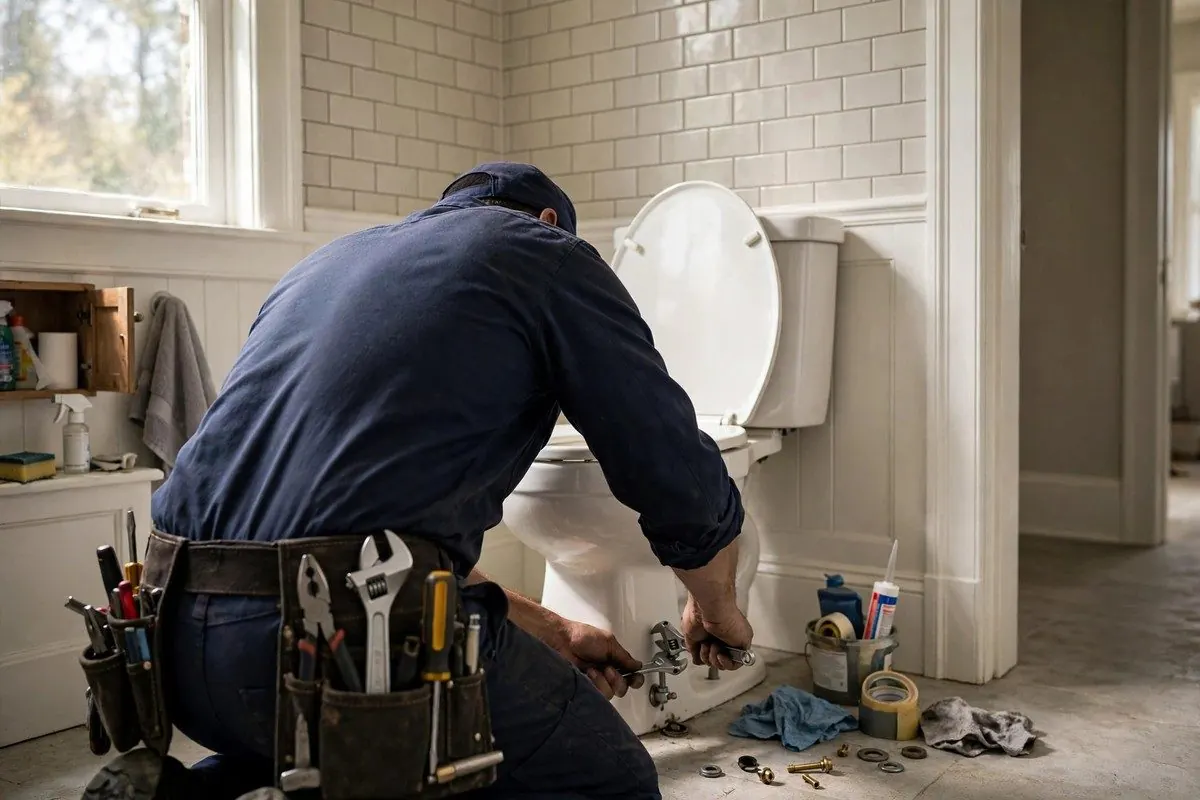
A toilet that will not stop filling, or one that is leaking onto the bathroom floor, needs attention right away. Our line for toilet repair in Fayetteville, GA is open 24/7. While you wait, turn the small oval valve behind the toilet clockwise until the water stops, and keep towels under the tank and bowl.
Most toilet problems come down to a handful of parts: the fill valve, the flapper, the wax ring, the flange and the drain path. Many repairs are finished in a single visit, and the price is clear before work starts.
Reading the symptom: what your toilet is telling you
Homeowners describe toilet trouble in plain terms: it runs on and off by itself, the handle feels loose, the bowl fills slowly, or the base rocks when you sit. The table matches the common ones to a part.
| What you notice | Likely cause | Usual fix |
|---|---|---|
| Tank refills every few minutes with no flush | Worn flapper letting water seep into the bowl | Replace the flapper and check the chain length |
| Hissing or constant running after a flush | Fill valve that no longer shuts off | Replace the fill valve and reset the water level |
| Water seeping around the base | Failed wax ring or loose closet bolts | Pull the toilet, replace the seal, reset it level |
| Toilet rocks side to side | Loose bolts or a damaged flange | Tighten, shim, or repair the flange |
| Weak flush, bowl drains slowly | Clogged rim jets or a partial blockage | Clear the jets and snake the trap |
Water on the floor or a bowl that keeps rising
An overflowing bowl or a steady leak at the base is the one toilet problem that should not wait for morning. Our dispatch line answers at night and on weekends, and same-day appointments are available when the schedule allows.
Stop the water
Turn the supply valve behind the toilet clockwise. If it will not move, close the main shutoff for the house.
Lift the tank lid
If the bowl is rising, push the flapper down into its seat. That stops more water entering the bowl.
Do not flush again
Another flush on a blocked line only adds to the spill.
Soak up what you can
Towels and a wet vac keep water from reaching subfloor edges and neighboring rooms.
Skip drain chemicals. They sit in the bowl, burn skin, and make the plumber's work less safe.
The parts that fail, and why they fail
The flapper is a rubber seal at the bottom of the tank. It softens, warps, or collects mineral film over time, and then it stops sealing. That is the most common cause of a toilet that runs when nobody has touched it.
The fill valve controls how much water enters the tank after a flush. When its seal wears, you hear a hiss, and the tank may keep topping off.
Below the bowl, a wax ring (or a modern wax-free seal) sits between the toilet and the flange, which is the ring bolted to the floor. If the toilet was ever knocked loose, or the flange rusted or cracked, that seal leaks. Leaks here run into the subfloor, so a soft spot or stained flooring around the base deserves a prompt look.
When the plunger fails: stubborn clogs
A flange-style plunger and steady, patient pressure clear most blockages. A toilet auger reaches farther without scratching the porcelain. If you have tried both and the bowl still drains slowly, the clog may be past the toilet itself.
That is the point to check other fixtures.
If a tub or sink nearby gurgles or backs up as well, the problem sits in the branch or main drain, and the right tool is a cable machine or a camera. Our drain cleaning crews handle that kind of blockage, and a toilet that backs up repeatedly can point to a bigger line problem that main line cleaning addresses.
- Never flush wipes marketed as flushable, paper towels, or feminine products.
- Keep a toilet auger in the house and use it gently, pushing until you feel the clog give.
Fixing the toilet or replacing it
Repair makes sense when the porcelain is sound and the trouble sits in inexpensive internal parts. It makes less sense when the toilet has a cracked tank or bowl, a leak that comes through the porcelain itself, or repeated clogs from an old high-volume design. A cracked bowl is a replacement job, not a repair.
Replacement is also worth thinking about when parts are hard to find or the same toilet has needed several fixes. The plumber can install a new one during the same visit.
What shapes the price of a toilet repair
Several things move the final number. A simple flapper or fill valve swap is a small job. Pulling the toilet to replace a seal takes longer, and a damaged flange or rotted subfloor adds repair work beneath it. After-hours calls can differ from daytime visits.
A good quote lists parts, labor, and any extra work separately, so nothing surprises you. We state the price before work starts and tell you plainly when something is a replacement job. For a number on your own toilet, call (770) 214-4545.
On insurance: homeowners policies generally respond to sudden accidental damage, such as an overflow that ruins flooring. They usually do not cover wear and tear or the cost of fixing the failed part. Policies differ, so check yours.
Toilets in Fayetteville homes built in the 1990s and 2000s
Fayetteville roughly doubled in population during the 1990s and kept growing, so much of the housing stock grew up in the 1990s and 2000s. Toilets from those years are now at the age when flappers, fill valves and supply lines wear out together. If one part has just failed, ask the plumber to check its neighbors while the tank is open.
We handle toilet repair across Fayetteville ZIP codes 30214 and 30215. A bathroom remodel that moves a toilet is a different job. Pipe changes may be involved, so see plumbing installation for planned work, and ask the Fayetteville building department whether permit rules apply before anything gets rerouted.
Toilet overflowing or leaking right now?
Shut the valve behind it, grab the towels, and call the dispatch line to get a plumber on the way.
Toilet Repair questions from Fayetteville homeowners
Yes. Our dispatch line is open 24/7 for overflowing bowls and leaks at the base. Close the supply valve behind the toilet first, push the flapper down if the bowl is rising, and then call. Same-day appointments are offered when available for problems that can wait a few hours.
A worn flapper is the usual reason. Water slowly leaks from the tank into the bowl, and the fill valve tops the tank back up. Add a few drops of food coloring to the tank and wait without flushing. If color shows up in the bowl, the flapper is leaking.
Not for long. A loose toilet strains the seal and can crack the flange, which turns a small fix into a larger one. Snug bolts sometimes solve it, but a toilet that keeps rocking needs a closer look.
If only one toilet clogs, the toilet or its trap is the likely cause. If several fixtures drain slowly or gurgle, look at the branch drain or main line. A camera inspection can show which. See sewer camera inspection for how that works.
Often yes. The plumber lifts the toilet, replaces the wax ring or seal, checks the flange, and sets it back level. If the flange or the floor beneath is damaged, that gets repaired first.
The part that failed, whether the toilet must be removed, flange or subfloor damage, and the timing of the visit all matter. Older models can cost more in parts and time. We state the price before work begins, and call (770) 214-4545 to talk through your situation.
Sources and standards. WaterSense, the EPA's water efficiency program, labels toilets that meet its efficiency standards, which helps when you choose a replacement. Installation follows the maker's instructions and the International Plumbing Code (IPC) as adopted in Georgia.