A water heater that has gone cold or started leaking will not wait for a convenient day, and the 24/7 line at Fayetteville 24/7 Plumbing is open for exactly that. While you wait for the technician, shut off the cold water to the heater, switch off its power or gas control, and keep clear of any pooling water.
Water heater repair in Fayetteville, GA means finding out why a tank or tankless unit stopped heating, leaks, rumbles, or runs lukewarm, then fixing the failed part when that makes sense. Same-day appointments are offered when available, and the plumber will tell you plainly if the unit is past saving.
Cold showers or water on the floor: do this first
No hot water and water coming from the tank both push a call to the top of the list. The leak matters more, because it can ruin flooring and drywall within hours. These steps are safe for any homeowner.
- Cold supply valve: turn the handle on the pipe above the tank to the closed position to stop water feeding a leak.
- Power or gas control: for an electric unit, switch off its breaker. For gas, turn the control knob to off, but only if you smell no gas.
- Where the water comes from: note whether it drips from the top fittings, the relief valve pipe, or the base of the tank.
Water at the base often means the inner steel has corroded through. That is usually a replacement job, not a repair. Leaks at top fittings and valves can often be fixed on the spot. If this is happening after dark, call (770) 214-4545 and describe what you see.
Symptom, likely cause, and the usual fix
| What you notice | Likely cause | Typical fix |
|---|---|---|
| No hot water, gas unit | Pilot out, dirty burner, or failed thermocouple or igniter | Clean or replace the failed part and relight safely |
| No hot water, electric unit | Tripped breaker, failed heating element, or bad thermostat | Test and replace the element or thermostat |
| Water warm but never hot | One of two elements dead, or a thick layer of sediment | Replace the element or flush the tank |
| Popping or rumbling noise | Sediment baked onto the bottom of the tank | Flush, and judge the tank condition afterward |
| Dripping from the relief valve pipe | Pressure too high, a worn valve, or a missing expansion tank | Test pressure and replace the valve or add a tank |
| Rusty or smelly hot water | Corroded anode rod or tank lining | Replace the anode rod if the tank is still sound |
Plenty of these faults come from one small part rather than a failed tank, which is why diagnosis comes before any quote.
Gas, electric, and heat pump units fail in different ways
Gas heaters rely on a flame, a vent, and a safety sensor. When one is dirty or worn, the burner shuts down. A weak thermocouple or a draft problem is a common reason the pilot keeps going out.
Electric tanks are simpler. Most have two heating elements and two thermostats. When only one element fails, you get short showers instead of none, which many people mistake for a small tank.
Hybrid or heat pump models add a compressor, a fan, and a condensate drain to the tank. They save energy, but a clogged air filter or a blocked drain can trip them into backup mode or a fault code. Keep the model label handy, since some repairs fall under manufacturer warranty terms. Tankless problems have their own page, covered under tankless unit service.
If you smell gas near the heater
What to do if gas is in the air: leave first, call second
A rotten-egg odor near a gas water heater is a safety matter before it is a plumbing matter. Do not flip switches, light anything, or look for the source. Get everyone outside, then call 911 or the gas utility from outside the building.
Call a plumber only after the gas utility or fire department has cleared the house. We make no promise about response time for gas leaks, because the utility has to deal with the gas first.
What a repair visit actually includes
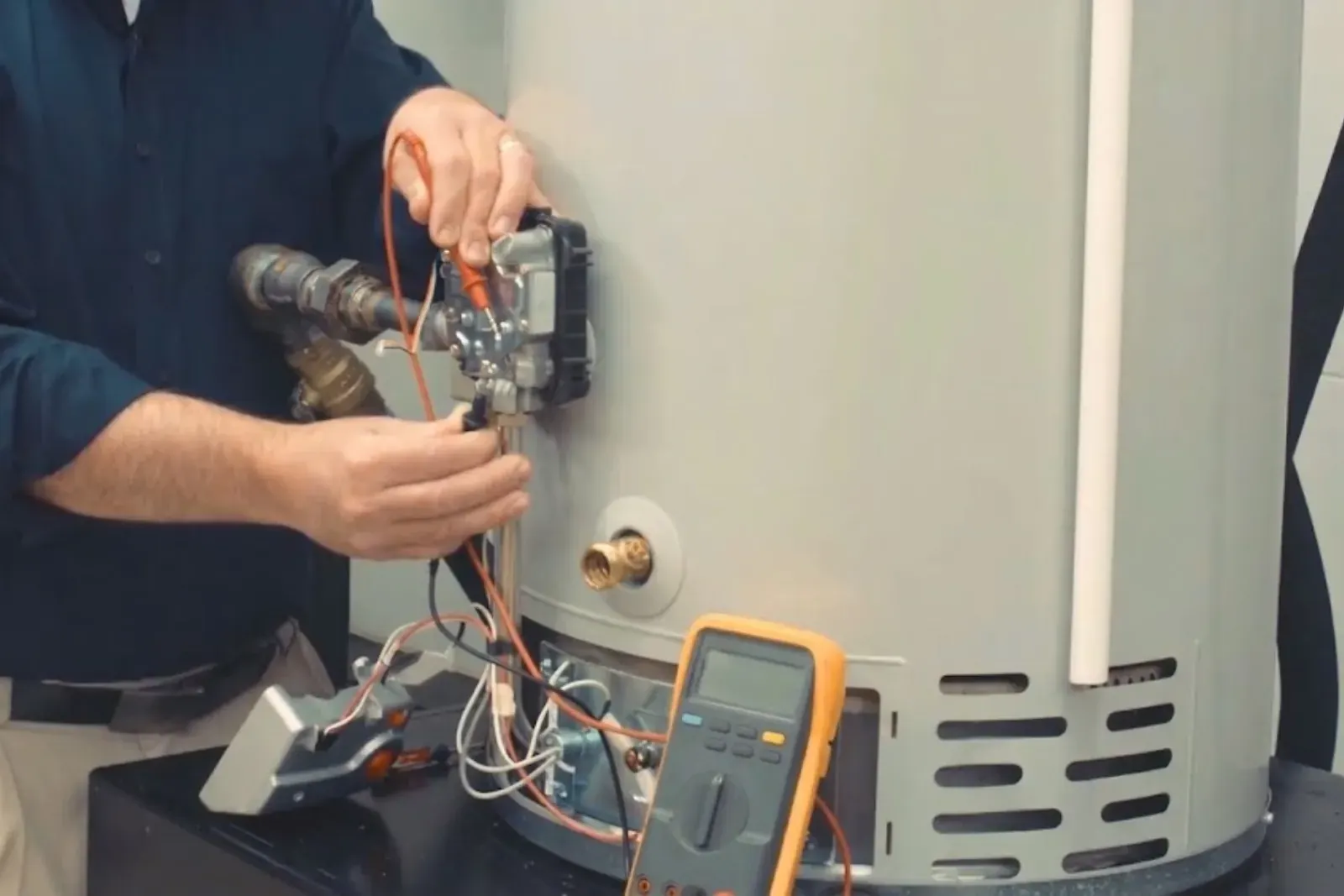
The technician starts by checking the unit's age, model label, venting, and water and gas or electric connections. Then come tests of the element, thermostat, burner flame, relief valve, and tank pressure.
Diagnose
Test power or gas supply, controls, and safety devices to pin down the failed part.
Explain the options
You get a clear price before work starts, with the repair and any alternative laid out. A planned swap to a different type of heater is handled as a new installation.
Repair and retest
The part is swapped, the unit is brought back up to temperature, and the relief valve and venting are checked.
A less common model may need a part ordered, and the plumber will say so honestly. The same visit covers homes in 30214 and 30215, the two Fayetteville ZIP codes this service reaches.
When fixing the old tank stops making sense
A repair is worth it when one part has failed on a tank that is otherwise sound. It stops being worth it when the tank itself is leaking, when the unit is near the end of its life, or when repairs keep stacking up. A leaking steel tank cannot be patched.
Much of Fayetteville's housing grew up in the 1990s and 2000s, so many original heaters are old enough that tanks tend to fail. If yours is one and the repair estimate is large, ask for the replacement figure side by side. The full picture of that decision lives on the replacement page.
What drives the cost of a heater repair
Price depends on which part failed, how hard it is to reach, and whether the unit sits in an attic, closet, or garage. Gas units may need venting or connection work that electric ones do not. A good quote lists the part, the labor, and any code-related items separately.
Insurance usually helps only when a sudden accident caused damage, such as a burst tank flooding a room. It generally does not pay for wear and tear or for the failed heater part itself, and policies differ, so read yours. For a quote on your unit, call (770) 214-4545.
No hot water and a tank you do not trust?
Call the 24/7 line and describe the symptom, and a licensed plumber will work out repair or replace.
Water Heater Repair questions from Fayetteville homeowners
On an electric tank, a failed element or thermostat is the usual cause, and a tripped high-limit button is another. On a gas unit, look for a pilot that will not stay lit. The technician can test each part rather than guess.
Yes. The dispatch line runs 24/7. Shut off the cold water to the tank, cut the power or gas control (only if you smell no gas), and keep people away from standing water until the technician arrives.
Not for long. A relief valve opens when pressure or temperature climbs too high, so repeated dripping needs testing. It can mean a worn valve or thermal expansion in the plumbing. Have it checked before it gets worse.
The failed part, how accessible the heater is, the fuel type, venting or connection work, and whether the model needs special-order parts. Ask for the part and labor itemized. Call for a price on your unit.
Minerals settle in a tank in different amounts depending on the water. Fayetteville's water comes partly from city wells and partly from the Fayette County Water System, and neither report gives a hardness figure. Test your tap or ask the utility for its annual water quality report.
A leak at a fitting, valve, or connection can be fixed. Water from the tank body means the steel has failed, and replacement is the honest answer.
Sources and standards. Repair steps follow the manufacturer's service instructions for your unit, which set the guidelines for gas, venting and relief valves. The National Fuel Gas Code (NFPA 54) covers gas piping and venting, and Georgia's plumbing code is based on the International Plumbing Code (IPC).