A tankless water heater warms water only when a tap opens, so there is no tank to run dry and no standby heat to pay for. Fayetteville 24/7 Plumbing installs, repairs, and maintains these units, including the flushing that keeps them working.
Tankless water heater service in Fayetteville, GA covers three jobs: fitting a new unit, fixing one that throws an error or turns lukewarm, and descaling the heat exchanger on a schedule. Below is how each works, what the house must supply, and where a tankless unit is a poor fit.
Gas and electric tankless units ask different things of your house
| Point | Gas tankless | Electric tankless |
|---|---|---|
| Hot water output | Higher flow for larger households | Fine for small homes or a single point of use |
| What the house needs | Adequate gas pipe, a sealed vent, and a condensate drain on some models | Heavy electrical capacity, often dedicated breakers |
| Install complexity | Venting and gas sizing drive the work | Electrical service upgrades drive the work |
| Upkeep focus | Heat exchanger scale and vent condition | Heating element scale and electrical connections |
Neither type is better in general. The choice usually follows what is already in the house and how much hot water you draw at once. A full comparison against tanks and heat pump models sits on the replacement page.
Sizing by flow rate and temperature rise
A tank is sized by gallons. A tankless unit is sized by how many gallons per minute it can heat and by how much it must raise the incoming water temperature. Colder incoming water means the same unit delivers less.
Add up what could run together: a shower, a dishwasher, a washing machine. If two showers and a laundry load overlap often, one unit may fall short. Some households install two units or choose a larger model, and the plumber can work through your habits with you.
Putting a tankless unit into an older house
Many Fayetteville homes date from the 1990s and 2000s, and their original gas lines and vent paths were built for a tank. A tankless unit asks for more gas at once and a different vent, so those parts are checked before anything is ordered.
- Gas line: measured for length and size against the unit's maximum demand.
- Vent: a sealed, approved vent material routed to the outdoors.
- Condensate drain: needed on high-efficiency gas models.
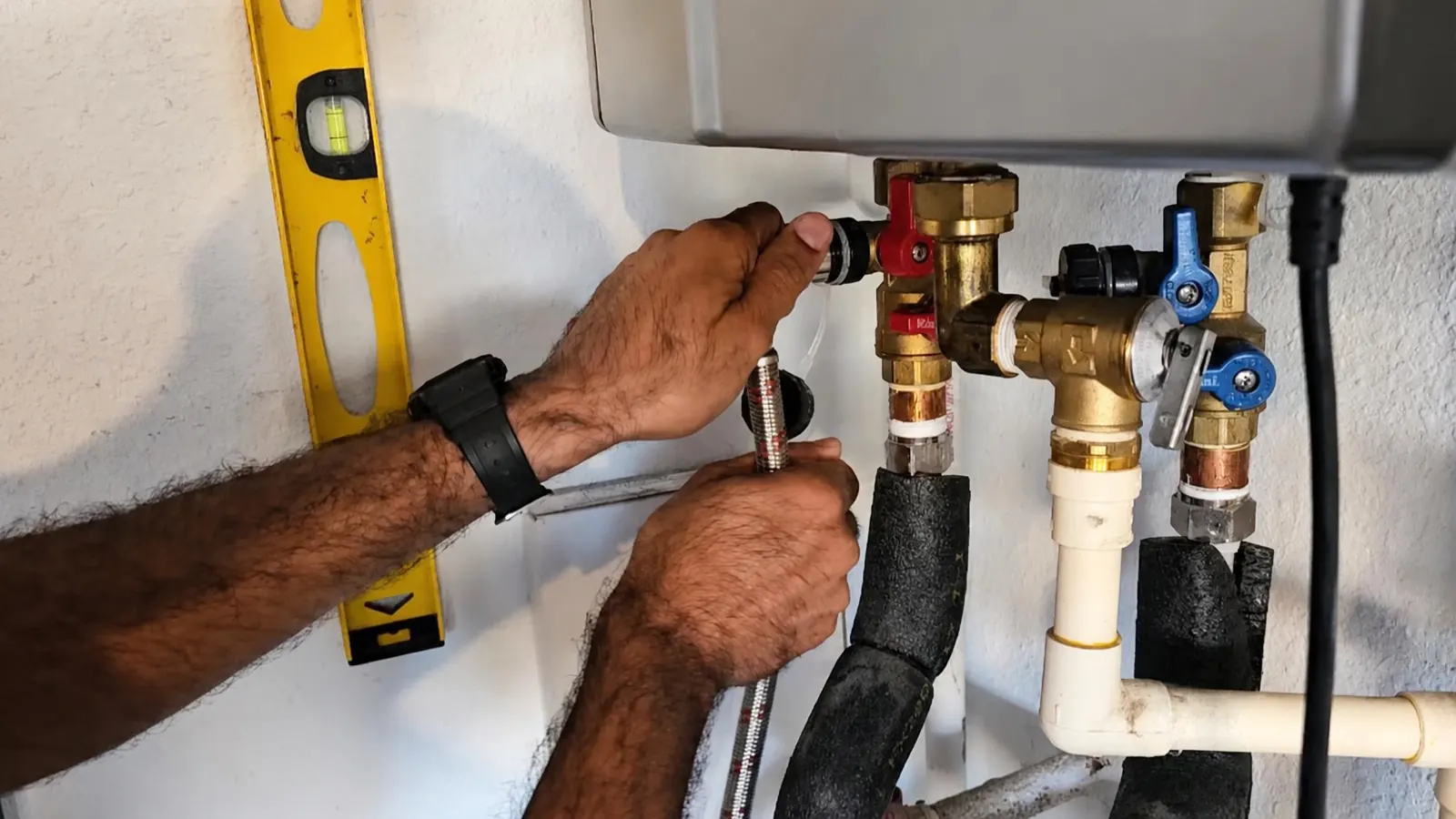
- Water connections: isolation valves with ports that make flushing easy.
- Power: an outlet or circuit for controls, or heavy wiring for electric models.
Permit rules vary, so ask the Fayetteville building department before a water heater swap or a gas line change. Our installation page goes through the surrounding work in more detail.
Flush and descale: the maintenance that decides how long it lasts
Minerals in the water bake onto the heat exchanger as scale. Scale narrows the passages, forces the unit to work harder, and eventually triggers errors or cuts output. A flush dissolves that buildup before it does damage.
How fast scale forms depends on the water. Fayetteville's supply comes about half from three city wells and half from the Fayette County Water System, and the published reports give no hardness figure. Test your tap, or ask the water utility for its annual water quality report. Then follow the manufacturer's interval, and flush sooner if your water leaves spots on glass.
A flush uses a small pump, hoses connected to the service valves, and a descaling solution that circulates through the heat exchanger. Then the unit is rinsed, the inlet screen is cleaned, and the temperature is checked. Skipping it is the most common reason a young tankless unit acts old.
Error codes, cold bursts, and other repair calls
Every maker uses its own codes, but they tend to fall into a few groups. Some point to ignition or flame trouble, some to venting or air supply, some to temperature sensors, and some to flow that is too low to fire the burner. The code on the display is a clue, not a diagnosis.
- Lukewarm water: often scale, a clogged inlet screen, or a flow rate below the unit's minimum.
- Brief cold stretch between uses: the unit's start-up delay, not always a fault.
- Unit will not fire: gas supply, ignition parts, or a blocked vent.
- Water leaking at the unit: a loose fitting is simple, but a cracked heat exchanger usually means replacement.
Before you call, write down the code, and note whether a faucet with low flow triggers it. If you ever smell gas, leave the house and call 911 or the gas utility first, and call a plumber only after the house is cleared. For tank-based problems, the repair page has the details.
When a tankless unit is the wrong choice
Tankless is not always the better buy. If the gas line cannot be enlarged at a sensible cost, or the electrical panel cannot carry an electric model, the upgrade work can outweigh the benefit. Very low flow fixtures can fail to trigger the burner.
Homes with lots of simultaneous hot water use may do better with a large tank or two units. A plumber should tell you this plainly, not sell you the model that looks best on paper.
Cost factors and what to expect for upkeep
Price depends on the model and capacity, fuel type, venting, gas or electrical upgrades, and where the unit mounts. Maintenance adds a recurring cost, and the flush is separate from the original install. Insurance generally covers sudden accidental damage, not wear and tear or the unit itself, and policies differ.
Service reaches homes in 30214 and 30215, the Fayetteville ZIP codes. To talk through your house, call (770) 214-4545.
Thinking about tankless or due for a flush?
Call and a licensed plumber can look at your gas line, vent, and unit.
Tankless Water Heater questions from Fayetteville homeowners
Follow the manufacturer's interval for your model. Water that leaves spots on glass or shows scale on fixtures may call for sooner flushing. Keeping the service valves accessible makes it quick.
Codes usually point to ignition, venting, air supply, a sensor, or low flow. Scale buildup can trigger several of them. Write down the code and when it appears before the plumber arrives.
It heats continuously, but only up to its flow limit. If demand exceeds the unit's capacity, the water turns lukewarm. Proper sizing is what keeps hot water steady.
Model and capacity, gas or electric, vent and gas line changes, electrical work, and the mounting location. Ask for each item written out. Call for a price on your house.
Not from a published figure, since none exists in the local reports. Test your tap, or ask the utility for its annual water quality report. Flushing on the manufacturer's schedule is the safe plan either way.
Often yes for space savings and no standby heat loss, but upgrade costs vary. If the gas line and vent need heavy work, a tank may make more sense.
Sources and standards. Flush and descale intervals should follow the manufacturer's instructions for your model. The U.S. Department of Energy's Energy Saver pages on tankless heaters are a neutral reference, and gas models fall under the National Fuel Gas Code (NFPA 54).