
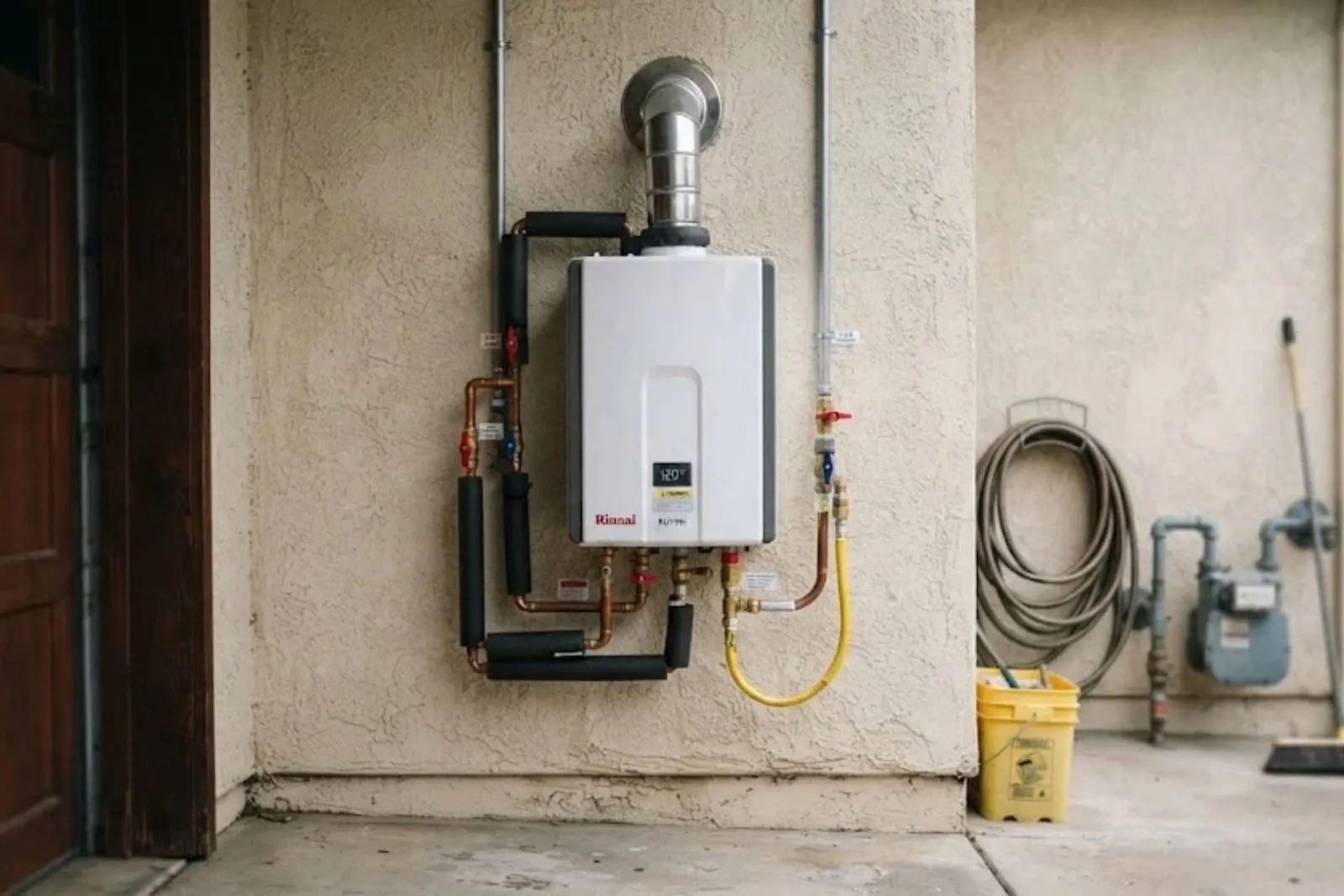
Yes, a gas tankless water heater can work in a Fayetteville, GA home, but the house has to be ready for it. The unit needs a properly sized gas line, a vent path that suits its design, and a water flow rate that matches how many fixtures run at once. Those three checks decide whether the retrofit is simple or turns into a bigger project.
This post covers what to measure before you buy, what a retrofit usually involves, and the maintenance that keeps a tankless unit running well.
Start with the gas line, not the heater
A tankless heater burns a lot of gas for a short time. A standard tank has a modest burner that runs longer, so the pipe that served it may be too small for a tankless unit. The plumber adds up the gas demand of every appliance on that line, then compares it to what the pipe, the meter, and the regulator can deliver.
If the numbers fall short, the fix is usually a larger gas branch from the meter or a nearer tee. That is real work, and it should appear as its own line on the quote. Gas line work is a licensed job, and permit rules vary, so ask the Fayetteville building department before any change.
Gas smell comes first
If you smell gas near any appliance, leave the building right away and call 911 or your gas utility from outside. Do not flip switches or look for the source. Call a plumber only after the utility says it is safe.
Venting: what changes from a tank heater
Many tankless units run hotter and push exhaust out through special sealed vent pipe, often plastic rated by the maker, rather than the metal flue a tank uses. Condensing models pull cooler exhaust and also produce acidic condensate that must drain somewhere. Non-condensing models vent hotter and need a different material.
The vent must be the material, diameter, and length the manufacturer specifies, and it must terminate where the code and the maker allow. Intake air matters too. Some units draw combustion air from the room, and others pipe it from outside. A garage or closet that worked for a tank may need louvers, or a different route.
Flow rate and temperature rise
Tankless sizing is about gallons per minute, not tank gallons. Add up the fixtures you might run together, such as a shower, a dishwasher, and a laundry cycle, then check the heater's rating at the temperature rise your cold supply requires. Incoming water is colder in winter, so a unit that feels strong in spring may struggle in January.
| Mistake | What happens | Better approach |
|---|---|---|
| Sizing for one shower only | Hot water fades when a second fixture opens | Count the fixtures that really run at once |
| Using summer water temperature | The unit cannot keep up in cold months | Size for the coldest incoming water |
| Ignoring long pipe runs | Hot water takes a while to arrive at far fixtures | Ask about a recirculation option |
| Skipping the gas check | Burner starves at high demand | Verify the line before ordering |
What a retrofit usually involves
Swapping a tank for a tankless unit is rarely a straight replacement. The old heater comes out, the wall space is rebuilt, and the new unit mounts on the wall with its own connections. Isolation valves go on the water side so the unit can be flushed later.
- Gas: confirm capacity, add or resize a branch, and pressure test the connections.
- Vent: run the correct vent material and set the termination.
- Power: most gas units still need a small electrical supply for the board and fan.
- Condensate: route it to a suitable drain if the model makes it.
- Water: install shutoff and service valves, and handle the old tank piping.
A gas-to-gas swap is common. A move from an electric tank to a gas tankless unit is a bigger change because it adds gas and venting that were not there. Our tankless water heater page explains the install and service options in more detail.
Keeping it healthy: maintenance in plain terms
A tankless heater has a small, tight heat exchanger. Mineral scale narrows it over time, which shows up as longer waits, lukewarm output, or error codes. A periodic flush with the right valves and solution clears it. Follow the manufacturer's interval, because it differs by model and by how scale-prone your water is.
Also clean the inlet screen if the model has one, check the vent for damage, and look for drips at the connections. If an error code keeps returning, write it down. The code tells a technician where to start. Our water heater installation team can also advise on valves and layout for a planned upgrade.
Gas tankless or stay with a tank?
A tankless unit can make hot water as long as the burner runs, which suits big households and long showers. It also frees wall or floor space. A tank is simpler, cheaper to maintain, and gentler on an older gas line.
If your house has a tight gas supply, a hard vent route, or modest hot water use, ask the plumber to price both options side by side. That comparison costs a phone call. When you are ready, call (770) 214-4545 and describe your current heater.
Fayetteville homes and water supply
The City of Fayetteville's 2025 water quality report says three deep wells supply about half the city's water, with the Fayette County Water System providing the rest. The county system draws from Lake Kedron, Lake Peachtree, Lake Horton, and Lake McIntosh. Neither report publishes a hardness figure.
That is why a flush interval cannot be guessed from the address. Test your own tap, and ask the utility for its annual water quality report.
In a house where much of the housing stock grew up in the 1990s and 2000s, the original gas line may also have been sized for a tank, so the line check is worth doing early. The same steps apply in Peachtree City, which has its own sewer authority.
Want a gas and vent check before you buy?
A licensed plumber can look at your line, flue, and fixtures and tell you what a tankless retrofit would need.
More questions answered
They keep heating as long as water flows and the burner runs, but each unit has a flow limit. If too many fixtures open at once, the temperature drops or the flow narrows. Sizing is what prevents that.
Sometimes, but often not. Tankless units usually need vent material and sizing set by the manufacturer. The plumber checks your existing flue against the instructions for the model.
Most gas models do. A small supply powers the control board and the exhaust fan. In a power outage the unit will usually not run, so ask about options if that matters to you.
Follow the manufacturer's interval. It varies by model. If your water tends to leave scale on fixtures, a plumber may suggest checking the unit more often.
The unit, gas line changes, venting material and route, condensate drainage, electrical work, valves, access, and permit steps all play a part. Ask that each be itemized. Call for a clear price before work starts.
Codes point to things like ignition problems, vent blockage, flow issues, or scale. Write the code down and check the manual. A technician can read the pattern faster with the code in hand.
There is no way to know from the age alone. Many homes from that period were piped for a tank heater, and other gas appliances share the same line. A plumber adds up the demand and checks the pipe, so ask for that check before you buy a unit.
Sources and standards. Venting and gas supply follow the manufacturer's instructions, the National Fuel Gas Code (NFPA 54) and Georgia's plumbing code, based on the International Plumbing Code (IPC). The U.S. Department of Energy's Energy Saver pages are a neutral guide to how tankless heaters work.