
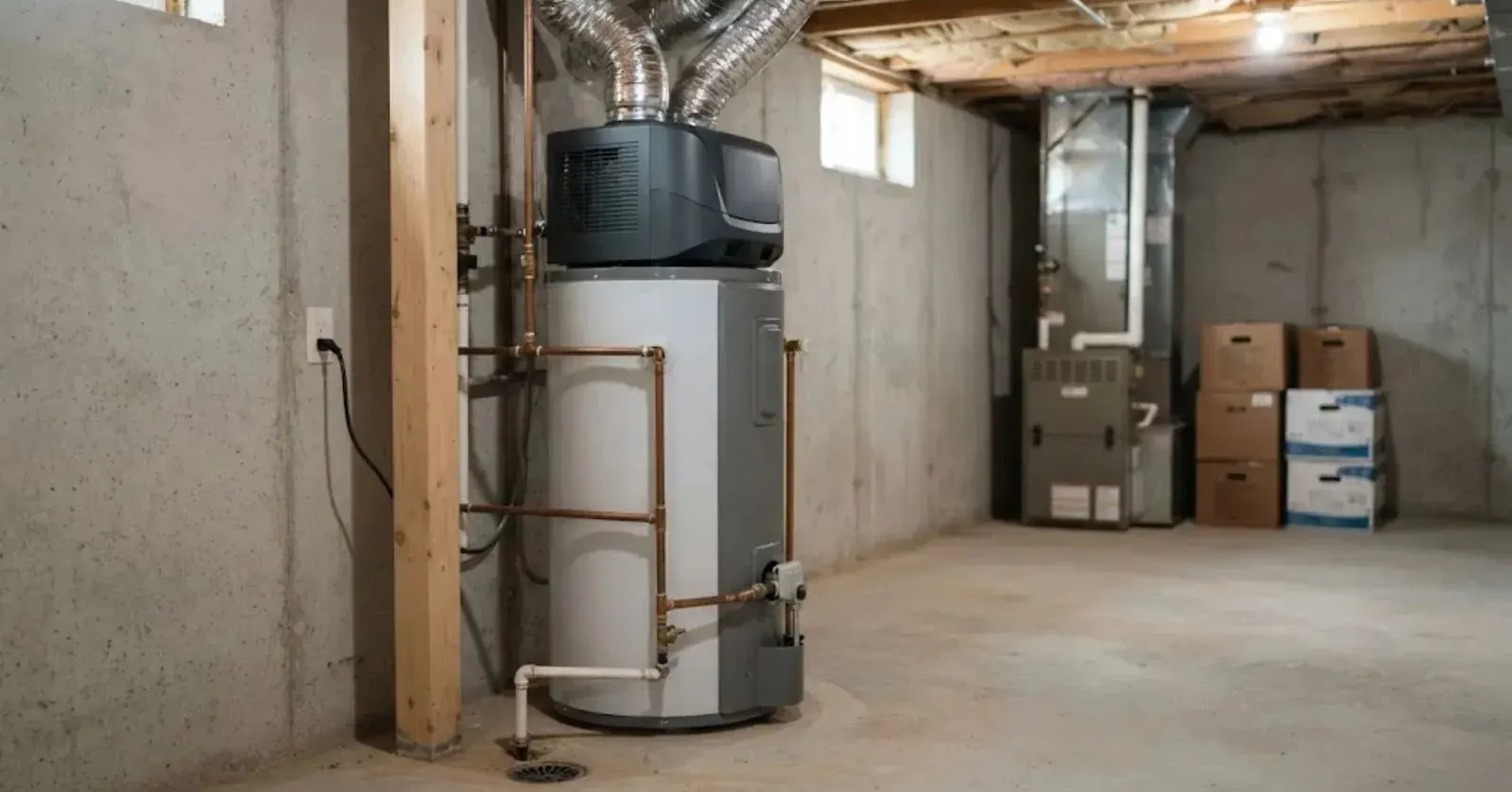
A heat pump water heater is an electric tank that pulls heat out of the surrounding air instead of making heat with a glowing element alone.
That makes it a good fit for some Fayetteville, GA homes and a poor fit for others. It works best when the unit sits in a roomy, ventilated space, has a nearby drain for condensate, and has the right electrical supply.
If your water heater closet is tight, unheated, or has no drain, a conventional tank is often the simpler install. This post walks through what the unit needs, who it suits, and where a standard tank still wins.
How a heat pump water heater actually makes hot water
Think of a refrigerator running in reverse. A fan draws room air across a coil, a compressor concentrates that heat, and the heat moves into the water in the tank. The unit uses electricity to move heat rather than to create it, which is why it can use less power than a standard electric tank.
Most models also carry backup electric elements. The control board can run in an efficiency mode, a hybrid mode, or an elements-only mode, depending on the model. Ask which modes your unit offers, because the mode you pick changes how fast the tank recovers after a busy morning.
One side effect surprises people. The unit cools and dries the air around it, so it hums a bit like a small dehumidifier and blows cool air out the top or side. That is normal, and it is also the reason placement matters.
Space, airflow, condensate, and power: the install checklist
These four needs decide almost every heat pump install. A plumber looks at them before quoting, because a missing one can change the whole plan.
| Need | What it means | Common fix if missing |
|---|---|---|
| Open air volume | The unit needs a minimum amount of air around it, set by the manufacturer | Move it to a larger room, or add louvered doors or ducting |
| Condensate drain | The coil sheds water that must go to a floor drain, a pump, or outdoors | Run a drain line or add a condensate pump |
| Electrical supply | Most models want a dedicated circuit, and the amperage differs by model | A licensed electrician confirms the panel and wiring |
| Height and clearance | These tanks are taller and often wider than a basic tank | Check door width and ceiling height before ordering |
Plumbing connections are the familiar part. The heater still needs shutoff valves, a relief valve discharge line, and often an expansion tank. Permit rules vary, so ask the Fayetteville building department before a water heater swap or any pipe rerouting.
Who gets the most out of one
A heat pump unit tends to pay off in homes that already use electric water heating and spend a lot of hot water each day. A larger household with several showers and a running dishwasher uses the efficiency advantage more than a one-person home does.
- Electric tank today: the swap keeps the same fuel and may need only a circuit check and a drain.
- Garage or basement with space: a large room gives the unit plenty of air to draw from.
- Interior utility room with a floor drain: condensate is handled without extra parts.
- Homeowners planning to stay put: the longer you keep the heater, the more the efficiency matters.
For a deeper look at what goes into a planned swap, see our page on water heater installation. It covers venting, sizing, and the code wording homeowners should expect.
When a conventional tank is simpler
Plenty of homes should stay with a standard tank. A water heater in a small closet has no air to borrow, and running ducts for it can cost more effort than the efficiency gain is worth. Gas homes face a bigger change, since a heat pump unit needs a 240-volt circuit that a gas house may not have near the heater.
Timing matters too. When the old heater has already failed and the household has no hot water, a heat pump swap that needs new wiring and a drain may take more than one visit. A like-for-like tank can often go in faster. If you are weighing a failed unit, our water heater replacement page explains what a full swap visit includes.
A fair rule of thumb
If the room has air, a drain, and a circuit, a heat pump unit is worth pricing. If it is missing two of the three, ask the plumber to price a standard tank beside it so you can compare honestly.
Noise, cool air, and other things to expect after install
The fan and compressor produce a steady hum. In a garage you may never notice it. In a utility room beside a bedroom wall, you might. Ask where the unit will sit before the day of the install.
The cool exhaust air is a feature in a warm garage and a nuisance in a conditioned closet that shares air with the house. Filters on the intake need an occasional rinse. The condensate line should be checked now and then so it does not clog, and the manufacturer's manual sets the schedule.
What a good quote should itemize
Heat pump installs vary more than standard swaps, so the written scope matters. Look for the unit and its model number, any electrical work, the condensate plan, the expansion tank and valves, haul-away of the old heater, and the permit step if the Fayetteville building department requires one. Each line should be separate so you can compare bids.
Rebates and tax programs change over time, so we do not quote any here. Ask the plumber and your electric utility what applies today. For a clear price before work starts, call (770) 214-4545 and describe your heater location.
What this means in Fayetteville
The City of Fayetteville history page says the city has more than 22,000 residents, up from 5,827 in the 1990 census. Much of the housing stock grew up in the 1990s and 2000s, so many homes have a water heater that has been in place for years and a layout built around a closet or garage corner.
That matters because a heat pump unit wants room to breathe. A garage corner with open air suits it. A tight closet near the hall bath usually does not.
On the coldest nights a garage in the Georgia Piedmont can drop low enough that the unit leans on its electric elements, so ask how your model behaves in cold air. The same questions apply across Highway 54 in Peachtree City.
Not sure your water heater room can host a heat pump unit?
Describe the space on the phone and a licensed plumber will tell you whether it is a good candidate.
More questions answered
No. A heat pump unit still stores hot water in a tank. A tankless unit heats water as it flows and has no tank. They are different machines with different needs. Our tankless water heater page covers that route.
Not safely for most homeowners. The job combines plumbing, electrical work, a drain, and a pressure relief valve. A licensed plumber and, where needed, a licensed electrician should handle it. You can check any Georgia plumber in the Secretary of State Licensee Search.
Yes, they make condensate as they run. That water needs a path to a floor drain, a pump, or outdoors. Skipping it risks a wet floor and a clogged line.
It cools and dries the air nearby, but only slightly in most garages. In a small closed room the effect is more noticeable. The manufacturer's sheet shows how much air the unit moves.
The unit itself, any new circuit or panel work, the condensate drain or pump, the location and access, the old heater haul-away, and permit steps all play a part. The quote should show each one. Call for a clear price before work starts.
A swap into a ready space can be a single visit. A job that needs new wiring, a drain line, or ducting can take longer or need a second trip. The plumber can tell you after seeing the location.
Usually yes, but the efficiency drops when the garage air gets very cold. Many models switch to their backup elements in that case, which still gives you hot water. Check the manufacturer's stated operating range for the model you are considering.
Sources and standards. According to the U.S. Department of Energy's Energy Saver guidance, heat pump water heaters pull heat from the surrounding air, which is why space and airflow matter. Follow the manufacturer's installation instructions and the International Plumbing Code (IPC) as adopted in Georgia.