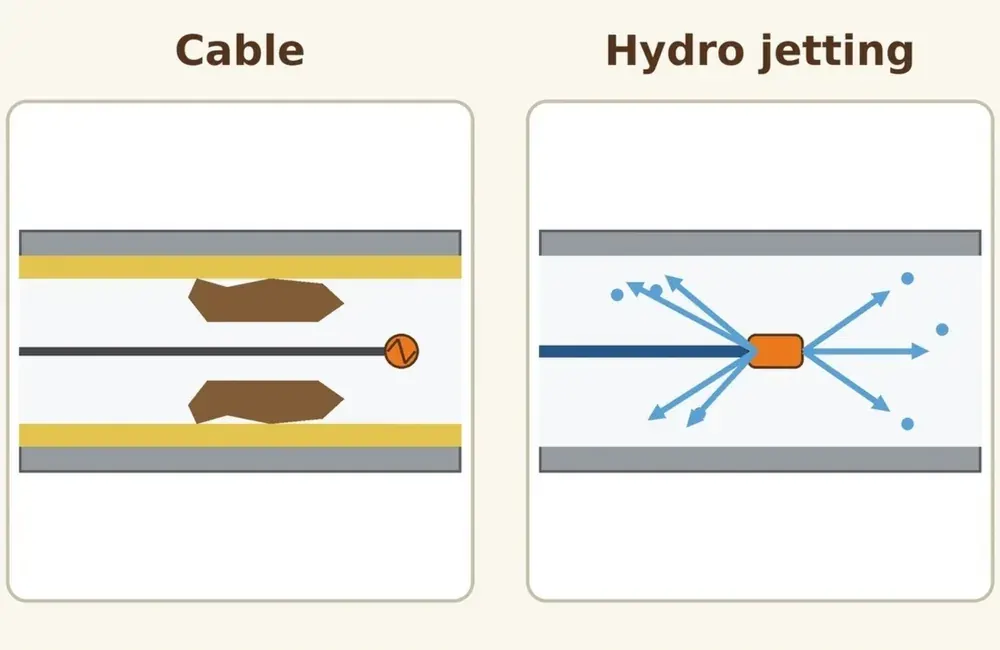
Hydro jetting and snaking both clear drains, but they work in different ways. A snake, also called a cable or auger, pokes through a clog and pulls or breaks it up.
Hydro jetting blasts the inside of the pipe with high-pressure water and washes the walls clean. For a simple one-time clog in Fayetteville, GA, a snake is usually enough. For grease, roots, or clogs that keep coming back, jetting often works better.
The right choice depends on what is in the pipe and what shape the pipe is in. This post lays out both tools side by side so you can ask the plumber better questions.
The short comparison
| Point | Snaking | Hydro jetting |
|---|---|---|
| How it works | A rotating cable pushes through the clog and hooks or cuts it | A nozzle sends water at high pressure to scour the pipe walls |
| Best for | Single clogs, hair, small blockages near a fixture | Grease, scale, sludge, root hair, and repeat clogs |
| What it leaves behind | A hole through the clog, with residue on the walls | A cleaner pipe from wall to wall |
| Pipe condition needed | Works in many pipes, but can scrape fragile ones | Needs sound pipe that can take the pressure |
| Setup | Quick, with a small machine | Larger equipment and a way to drain the water |
| Typical result | Water flows again, but buildup may remain | Walls are scoured, so the pipe can stay clear longer |
How a snake clears a clog
A drain machine feeds a coiled steel cable into the line. The head spins as it advances. When it meets the clog, it either bores through it or catches it so the plumber can pull it out. Heads come in different shapes for hair, paper, or soft blockages.
Snaking is fast and does little to the surroundings. The weak point is that it opens a channel rather than cleaning the pipe. Grease on the walls stays. Over time the channel narrows again, and the symptom returns.
How hydro jetting works
Hydro jetting sends water through a hose and nozzle. Jets point backward to pull the hose forward and forward to break up the clog. The water scours the full circle of the pipe wall, flushes the debris to the main, and leaves the pipe much cleaner than a cable can.
The tool shines on thick grease, mineral scale, and fine roots. It is not a cure for a broken pipe, and the plumber should confirm the line is sound first. Our hydro jetting service starts with that check.
Which one fits your drain
Match the tool to the symptom. These rules of thumb help:
- One slow sink, first time: snake it. A simple clog does not need a jet.
- Same drain clogs every few weeks: jetting is worth a look, since buildup is likely on the walls.
- Snake got stuck or only made a small hole: ask about jetting, once a camera has checked the pipe.
- Kitchen line with heavy grease: jetting handles the coating better than a cable.
- Roots in a sewer line: a cable can cut roots, while jetting clears the fine hair. A camera shows which is needed.
- Old or cracked pipe: neither tool is a fix, and a repair plan may come first.
For a basic stoppage, our drain cleaning service covers both cabling and the camera work that tells you what is next.
Cautions for old or damaged pipe
Pressure is a strength and a risk. Old clay, thin cast iron, and pipe with cracked joints can break open under a hard jet. Water can also escape through a bad joint and soak the soil around it.
A camera look before jetting is the safe order of work. If it shows a crushed section or a bad offset, a plumber may suggest a repair first. The same caution applies to snaking, since a hard cable can snag on a broken edge. When the footage looks risky, the plumber should say so rather than push ahead.
What a homeowner can do first
Before you book either service, rule out the simple causes. Lift the stopper and clean it, try a plunger, and check whether only one fixture is slow. If several drains back up together, stop using water and call, because the problem is probably in the main line.
Keep grease, coffee grounds, and wipes out of the drain. Wipes marked as flushable still build up in a sewer line. Do not pour chemical cleaners in a drain that is completely blocked, since the plumber may need to work in that standing water.
If you are unsure which tool fits, call (770) 214-4545 and describe the symptoms. We give a clear price before work starts.
Reading the quote
Compare quotes by scope. Ask which tool is planned, whether a camera is included, where the plumber will access the line, and what happens if the first tool fails. A jet job costs more than a cable job in most cases, so the plumber should explain why jetting is worth it for your pipe.
If you hear that one tool is always better, be careful. A good plumber picks the tool from what the pipe shows, not from habit.
Where this plays out in Fayetteville
Fayetteville has a busy commercial strip along Highway 85 North, plus retail centers such as Fayette Pavilion and Banks Crossing. Kitchens in that kind of setting send a steady stream of grease down the drain. If you manage a food business there, repeat clogs are a hint that the walls of the line need cleaning, not just a hole through the middle.
For homes, much of the housing stock grew up in the 1990s and 2000s, so many drain lines are about two decades old. That is usually fine for jetting, but it is a reason to have a camera check first. Homes near Peachtree City and other Fayette County towns follow the same logic, since the pipe condition decides the tool.
Not sure which tool your drain needs?
Tell the dispatcher what the clog has been doing and ask which method makes sense after a camera look.
More questions answered
On sound pipe, it is a standard method. On old, cracked, or poorly joined pipe it can cause harm, which is why a camera check comes first. The plumber should be willing to show you what the pipe looks like.
Usually, because the equipment and time are smaller. The cheaper tool is not always the better value if the clog returns, so weigh the cost against how often the drain has failed.
It can scratch or snag a fragile pipe, particularly with a heavy cable in a cracked section. A careful operator uses the right head size and stops when the cable meets unusual resistance.
It depends on what caused the clog. Jetting removes buildup from the walls, so grease and scale take longer to return. Roots can regrow, and a damaged pipe will clog again regardless of the tool.
It is smart for repeat clogs, snake jams, and sewer lines. The footage tells the plumber which tool is safe and gives you a record of the pipe.
Not usually. A toilet clog is normally cleared with a plunger or a closet auger. Jetting is for the drain line behind it, when more than the toilet is affected.
For a grease-heavy line, jetting is usually worth asking about, since it cleans the pipe walls. Have a camera confirm the line is in good shape, and ask whether a grease trap is part of the problem. Our commercial team can help with scheduled work.
Sources and standards. Equipment guidelines come from the machine and nozzle makers, and pipe condition findings follow how inspectors code defects under NASSCO's Pipeline Assessment Certification Program. Georgia's plumbing code is based on the International Plumbing Code (IPC).