A tankless water heater flush is a short service that runs a mild descaling solution, usually white vinegar or a maker-approved cleaner, through the heat exchanger to dissolve mineral buildup. Fayetteville, GA homeowners should do it on the schedule the manufacturer sets, because no published report tells us how hard the local water is.
Skip the flush and scale can narrow the passages, trigger error codes, and shorten the life of the unit. Here is why scale forms, how the flush works, and who should do it.
Why minerals stick inside a tankless unit
Water carries dissolved calcium and magnesium. Heat makes those minerals drop out of the water and cling to the hottest metal they touch. In a tankless heater, that metal is the heat exchanger, where water passes through narrow channels at high temperature.
A layer of scale acts like a blanket. The burner or element must work harder to heat the same water, and flow slows as the passages shrink. You may notice lukewarm output, a longer wait for heat, louder operation, or an error code.
How the flush works, step by step
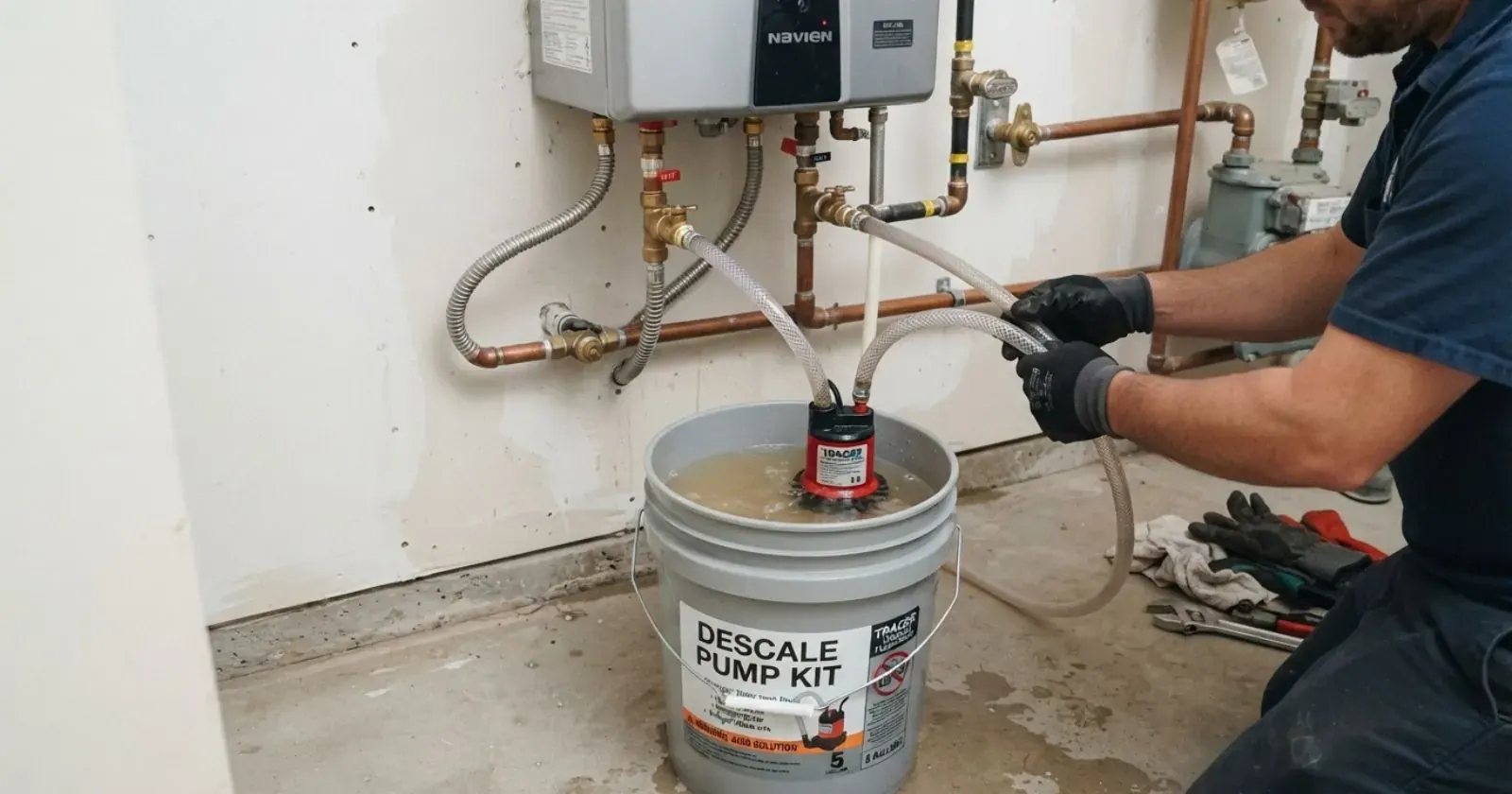
The idea is simple. You circulate a descaling solution through the heat exchanger and then rinse it out. A pump and two hoses do the circulating, which is why the unit needs isolation valves.
Power down
Turn off the unit's power, and gas where required, and close the water shutoffs.
Connect the loop
Attach hoses from a small pump and a bucket to the service valves on the hot and cold sides.
Circulate
Run the solution through the exchanger for the time the manufacturer lists.
Rinse
Flush with clean water until the discharge runs clear.
Restore
Close the service valves, reopen the shutoffs, check for drips, and power the unit back on.
Plan for a clear workspace and a bucket large enough to hold the discharge. The used solution can be cloudy and may carry loose flakes of scale. Pour it where local rules allow, and keep towels handy for the moment you pull a hose off a valve.
Always follow the manual for your model. The solution, the time, and the valve positions differ, and a wrong step can damage seals or trap air.
Follow the manufacturer, not a guess
Every maker publishes a flush interval for its units, often tied to water hardness. Use the one in your manual. We do not invent a schedule here, because the right one depends on your model and on your water.
If your fixtures show white crust, your kettle scales up quickly, or the unit throws codes between flushes, tell the plumber. A heavy scale pattern can justify checking the unit sooner than the manual's baseline.
Do it yourself, or hire a plumber?
| Question | DIY homeowner | Plumber |
|---|---|---|
| Isolation valves already installed? | Needed. Without them, the job is hard | Can add them |
| Comfort with hoses, power, and gas shutoff | Fine if you follow the manual | Handles it routinely |
| Error codes or poor flow | May need diagnosis first | Diagnoses and flushes in one visit |
| Heavy scale | Solution may not clear it | Can judge if more is needed |
| Gas, vent, and leak check | Easy to skip | Included in a proper visit |
Many homeowners handle a flush when the valves are in place and the manual is clear. If the unit has no service valves, if it is gas-fired and you are unsure, or if codes are already showing, a plumber is the better call. Our tankless water heater page covers flush and descaling service.
Water-side extras that cut scale
- Inlet screen: clean it if your model has one, since debris restricts flow.
- Temperature setting: a lower setpoint slows scale growth, within what the household needs.
- Water treatment: a softener or scale inhibitor may help. Ask the maker which types it accepts.
- Test your tap: a simple hardness kit or lab test gives you a real number for your house.
Keep a simple log as well. Note the date of each flush, the solution used, and how the rinse water looked. That record helps a plumber judge how fast scale is forming in your house, and it supports any warranty question later. Photos of the discharge bucket are enough.
A softener changes more than the heater, so weigh it against your whole plumbing system. A plumber can talk through the trade-offs for your home.
When the problem is not scale
A flush will not fix every symptom. A failing sensor, a vent problem, a gas supply issue, or a bad flow switch can look just like scale. If you smell gas at any time, leave the building and call 911 or your gas utility from outside before you call a plumber.
For repeated codes after a clean flush, book service. Our water heater repair page explains how a technician reads codes and tests parts. When you want the unit checked, call (770) 214-4545. Ask what the visit includes so the quote lists the flush, the leak check, and any parts.
What Fayetteville water tells us, and what it does not
The City of Fayetteville's 2025 water quality report says the city draws from three deep wells for about half its water, and the Fayette County Water System supplies the rest. The county system uses Lake Kedron, Lake Peachtree, Lake Horton, and Lake McIntosh, and its 2024 report says Flint River water is pumped to Lake Horton when needed. Lime is used to adjust pH.
Neither report publishes a hardness figure, so we will not guess one. Test your own tap and ask the water utility for its annual Consumer Confidence Report. Because wells and lake water can blend at the tap, your result is the number that counts. The same applies in Peachtree City, which sits on the Peachtree City Water and Sewerage Authority for sewer.
Time to descale your tankless heater?
A licensed plumber can flush the unit, add service valves if needed, and test for leaks.
More questions answered
Many makers list white vinegar or their own cleaner. Others specify a product. Check the manual for your model before you choose, because the wrong solution can harm parts.
It depends on the model and the manual. The circulation step runs for a set time, plus setup and rinse. Allow a window rather than a quick job.
A plumber can add isolation valves to the hot and cold lines. They make future flushes much easier. Without them, flushing is difficult and you risk leaks.
Some makers tie warranty terms to proper maintenance. Read your warranty and keep notes of each flush. Ask the maker if you are unsure.
Whether valves exist or must be added, how much scale there is, the unit's access and location, and any diagnosis or parts. A good quote lists each. Call for a clear price before work starts.
Sometimes, if scale is the cause. A code that returns after a clean flush points to something else, such as a sensor or vent issue. A technician can test it.
The city and county reports we reviewed give no hardness figure, so no one can say from the address alone. Test your tap, check the utility's Consumer Confidence Report, and follow the manufacturer's interval. Tell the plumber if you see scale on fixtures.
Sources and standards. Follow the manufacturer's flush guidelines for your model, because intervals and procedures differ. The U.S. Department of Energy's Energy Saver pages explain how tankless heaters work, and your utility's annual water quality report is the right source for local water facts.