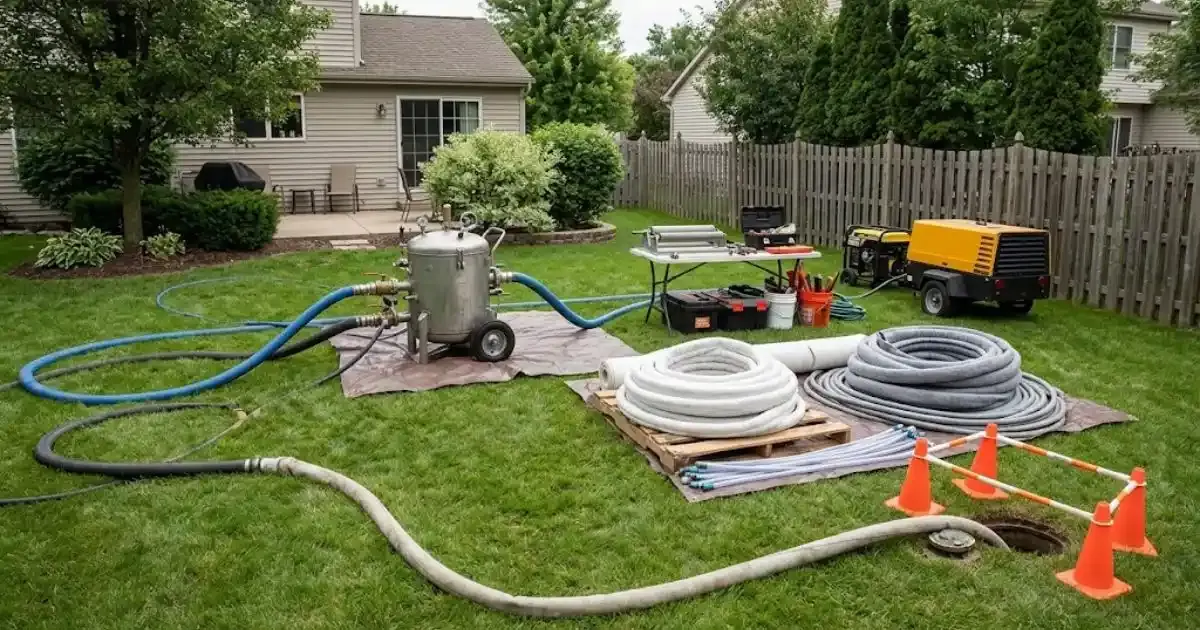
Trenchless sewer line repair fixes a damaged sewer pipe without digging a long trench across your yard.
In Fayetteville, GA, it usually means one of two methods: lining the old pipe with a new resin sleeve, or pulling a new pipe through the old path while the old one breaks apart. Both need only a small access pit or two. Neither works on every pipe, which is why a camera look comes first.
Below you will find how each method works, when digging is still the better call, and what to do about roots, utility lines, and the connection to the city sewer.
Start with a camera, not a shovel
Every good repair plan begins with seeing the pipe. A small camera on a flexible cable runs through the line and records what is there. It shows cracks, offsets, root intrusion, sagging sections, and the pipe material.
That footage decides which methods are even possible. A pipe with a deep belly holds water, and a liner cannot fix the dip. A clean crack in a straight run is a good candidate. Our sewer camera inspection gives you the recording before you commit to any repair.
Pipe lining in plain words
Lining starts with cleaning the pipe so the sleeve will bond. The crew then pulls a flexible tube soaked in resin into the old pipe. It is inflated against the wall and left to harden. The result is a new pipe inside the old one.
Lining works well for cracks, small gaps, and root entry at joints. The inside diameter shrinks a little, but flow usually stays good. It cannot fix a collapsed section or a pipe that has lost its shape.
Pipe bursting in plain words
Pipe bursting replaces the line. A cone-shaped head is pulled through the old pipe. It cracks the old material outward into the soil and drags a new pipe in behind it. The new line can match or exceed the old diameter.
This suits pipes that are too damaged to line, such as broken clay or heavily rooted runs. It needs an entry pit at one end and a receiving pit at the other. Nearby buried lines and tight spaces can limit it.
Three paths side by side
| Method | Best for | Trade-off |
|---|---|---|
| Lining | Cracks, joint leaks, root entry in a pipe that still holds its shape | Cannot fix collapses, bellies, or badly offset joints |
| Pipe bursting | Failed or broken pipe along a mostly straight path | Needs pits at both ends and room to work |
| Open trench | Collapsed or sagging pipe, tight bends, connections that must be re-cut | More digging, landscape repair, and longer disruption |
There is no best method in general, only the best one for what the camera shows. If a plumber recommends one without showing footage, ask to see it.
When trenchless does not fit
Trenchless is not magic, and an honest plumber will say when it does not apply. These conditions usually push a job back toward digging:
- Collapsed pipe: a liner or burst head cannot pass a fully crushed section.
- Belly in the line: a low spot that holds water needs the pipe regraded, not sleeved.
- Sharp turns: tight bends are hard to pull through or line smoothly.
- Broken connections: a bad joint at the cleanout or the main tie-in may need an open cut.
- Multiple failures: several different problems along the run can make one clean repair impossible.
If your line falls into one of these groups, read the repair options on our sewer line repair page and ask for a plan that explains why.
Roots: the reason many lines fail
Tree roots look for water, and a small crack or loose joint is an open invitation. Once inside, they grow thicker and catch paper and grease. The pipe slows down, then stops.
Cutting roots clears the line for a while. Lining seals the joints so new roots cannot get in. If the pipe is already crushed by roots, bursting or digging may be needed. Either way, the camera tells you whether the roots are the cause or just a sign of an older failure.
Call 811 before anything is dug
Even trenchless work opens pits, and pits can hit buried gas, power, and water lines. Georgia homeowners and contractors call 811 before digging, and utilities mark their lines. Ask your plumber who is placing the call and when.
Marks do not show your private lines, such as a sprinkler line or an old yard drain. Tell the crew what you know about them before work starts.
Questions to settle before you agree to work
Ask for these in writing
Which method is proposed, and what in the camera footage supports it.
Where the access pits will be, and how the yard will be restored.
Whether a permit is needed. Permit rules vary, so ask the Fayetteville building department.
What happens if the camera or the cleaning shows a worse problem than expected.
We give a clear price before work starts, and the scope should say which method, which section, and what is not included. For a talk about your own line, call (770) 214-4545.
The city sewer connection in Fayetteville
Fayette County lists the City of Fayetteville Water and Sewerage Authority as the sewer provider for Fayetteville. Homes in the 30214 and 30215 ZIP codes connect to city sewer, so your private line runs from the house to the authority main. The repair you pay for is generally on your side of that connection, and work at the main itself is a conversation with the authority.
That split matters for planning. A lining or burst job usually ends at the tie-in, and the camera helps show where your pipe stops. Much of the local housing stock grew up in the 1990s and 2000s, so older lines may be due for a look.
Clay-rich Piedmont soil also holds moisture, which is one more reason roots find their way to pipes. If you live closer to Peachtree City, that city has its own sewer authority, so check who serves your address.
Think the sewer line is cracked or rooted?
Talk through the symptoms and ask about a camera visit to see which repair method fits.
More questions answered
No. It means much less digging. Crews still open a pit or two to reach the pipe, and some jobs need a short open cut at a connection.
Typical signs are several drains backing up together, gurgling toilets, sewage smells in the yard, or soggy ground along the line. A camera inspection confirms it and shows where.
It narrows the inside a little, but the smooth new surface usually moves water well. The plumber should explain the sizing for your line before starting.
A sealed liner or a new pipe with tight joints blocks most entry points. Roots can still push on a pipe from outside, so a periodic camera check is sensible if trees are close.
Not always. Yard restoration savings can offset the method cost, but the pipe condition decides what is possible. Ask for each option priced on its own scope.
Limit water use, because every flush and load of laundry adds to the line. If sewage is backing into the house, keep people and pets away from it.
Call a plumber to camera the line, then confirm with the City of Fayetteville Water and Sewerage Authority whether the problem sits on your side of the connection or in the main. Call 811 before any digging starts.
Sources and standards. Pipe lining practice is described in ASTM F1216, a standard practice for rehabilitating a pipe with a resin-impregnated tube. Call 811 before any digging, and ask the Fayetteville building department about permits for sewer work.