
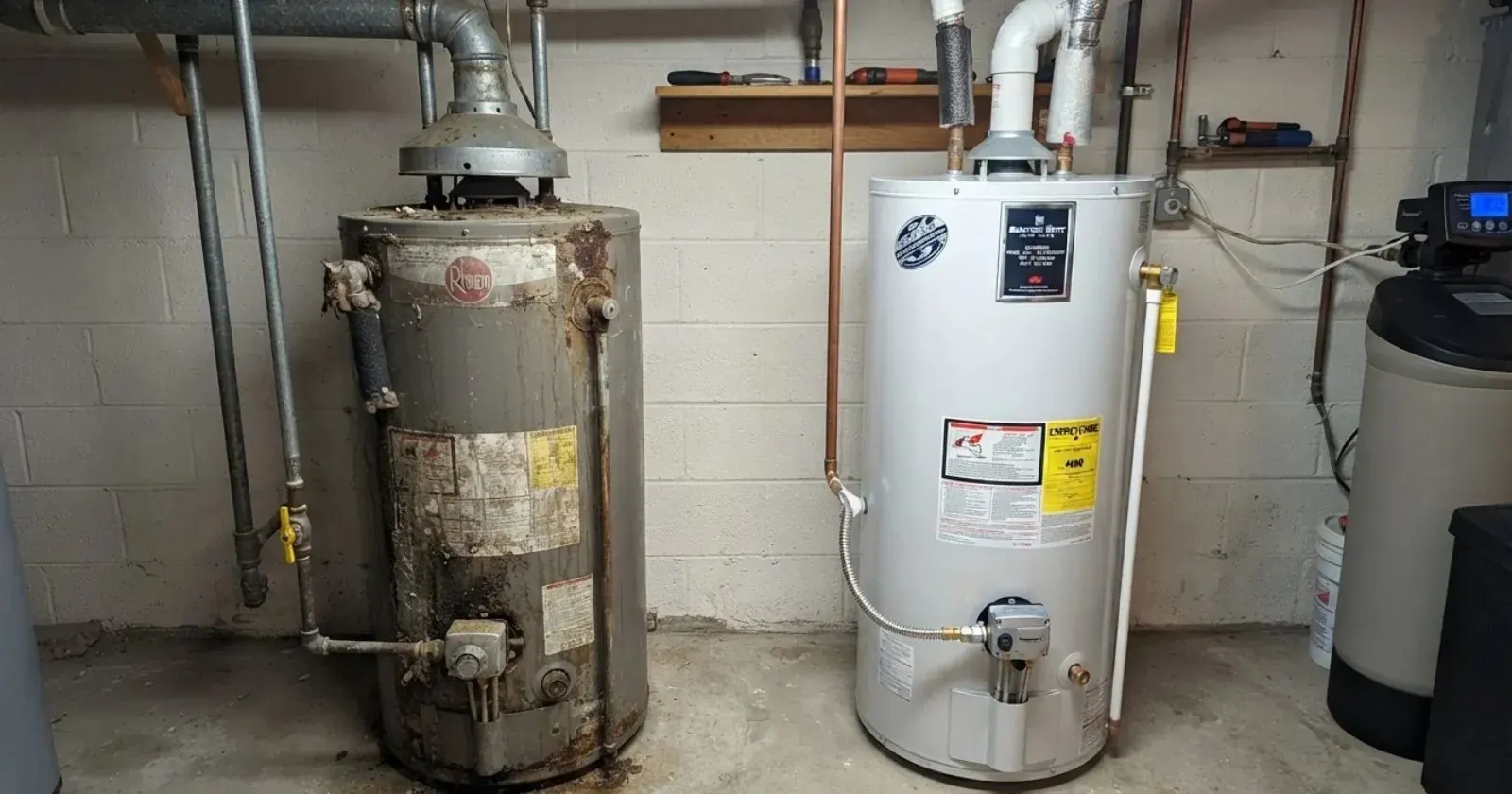
Repair a water heater when the tank is sound and the fault is a single part, such as a thermostat, element, igniter, or valve. Replace it when the tank itself leaks, when it is old and failing in more than one way, or when repairs keep stacking up. That is the short answer for most Fayetteville, GA homeowners.
The rest of this post gives you a symptom table, a way to think about age, the cost factors behind each choice, and what a written quote should list so you can compare the two honestly.
The decision table: symptom first
Start with what the heater is doing. The table pairs common symptoms with the usual direction. A technician confirms the cause on site, so treat this as a map, not a verdict.
| Symptom | Likely cause | Usual direction |
|---|---|---|
| No hot water, electric tank | Failed element or thermostat | Repair if the tank is sound |
| No hot water, gas tank | Igniter, thermocouple, or gas valve | Repair if the tank is sound |
| Water pooling under the tank | Leak at a fitting or valve, or a failed tank | Fitting leak: repair. Tank leak: replace |
| Rusty or discolored hot water | Corroded tank, or aging anode rod | Often replace, check first |
| Rumbling or popping noises | Sediment baked on the tank bottom | Flush may help, heavy buildup points to replace |
| Water too hot or lukewarm | Thermostat, mixing, or sediment | Usually repair |
Age logic without a magic number
Tank heaters wear out. The metal inside corrodes, sediment builds, and the protective anode rod is used up. The manufacturer's data plate has a serial number that encodes the build date, and the maker's website or manual explains how to read it.
Age matters as a trend, not a cutoff. A young heater with one bad part is a repair. An older heater that has already needed a part, shows rust at the base, or is slow to recover is closer to the end. If the tank is well past the typical life the maker states for that model, a repair buys less time.
Ask yourself a simple question: if this part fails again in a year, will I regret the money I put in today? If the answer is yes, ask for a replacement quote beside the repair.
Red flags that point to replacement
- Water leaking from the tank body, not from a fitting or the relief valve.
- Rust-colored hot water that does not clear after a flush.
- Repeated repairs in a short time, on a heater that is already old.
- Heavy sediment that blocks heat transfer and shortens element or burner life.
- Cracked or bulging tank, or visible corrosion at the seams.
- Capacity no longer matches the household, so the heater runs constantly and still falls short.
A leak is the clearest case. A fitting or relief valve can be repaired. A hole in the tank cannot. Shut off the cold water supply to the heater, shut off power or gas to it, and call. If you smell gas, leave first and call 911 or the gas utility.
What drives the cost of each path
Repairs cost less up front, and a good repair on a sound heater is the best value. A replacement costs more up front and brings a new tank, a fresh start on wear, and often better efficiency. Neither has a standard price, and the factors below explain why quotes differ.
| Factor | Repair | Replacement |
|---|---|---|
| Parts and unit | Cost of the one failed part | Cost of the new heater and fittings |
| Labor time | Diagnosis and swap | Draining, removal, install, startup |
| Code items | Rarely changes | Venting, expansion tank, relief line, and permit steps |
| Access | Affects reach to the part | Affects hauling the old tank out |
| Fuel or type change | Not involved | Switching to tankless or heat pump adds work |
Permit rules vary, so ask the Fayetteville building department before a water heater swap. For a clear price before work starts, call (770) 214-4545.
What a written quote should itemize
Whether you pick repair or replacement, ask for the scope in writing. A repair quote should name the part, the labor, and the test done after. A replacement quote should name the unit and model, its size, venting or flue work, an expansion tank if needed, valves, the relief line, haul-away, and the permit step if any.
Compare the two on the same page. The technician who arrives should be willing to explain why one path fits your heater better. Our water heater repair and water heater replacement pages describe what each visit includes.
Insurance note
Homeowners policies generally respond to sudden accidental damage, not to wear and tear or the repair of the failed part itself. Policies differ, so check yours before assuming anything is covered.
Switching type while you are at it
A replacement is the natural time to ask about a different kind of heater. A tankless unit saves floor space and heats on demand. A heat pump unit uses less electricity but needs room and a drain. Each has trade-offs, and our water heater installation page lays out what changes in the pipes, vent, and power.
If the heater is in a tight closet or the gas and electric supply are limited, a like-for-like tank is often the smooth choice. Ask the plumber to price both, then choose.
Where Fayetteville homes sit on the age curve
The City of Fayetteville history page cites more than 22,000 residents, up from 5,827 in the 1990 census. Much of the housing stock grew up in the 1990s and 2000s. A heater original to a home from that period may now be well along in its life, so look at its data plate.
The water matters too. The City of Fayetteville's 2025 water quality report says deep wells supply about half the water and the Fayette County Water System supplies the rest.
Neither report publishes a hardness figure, so sediment in your tank is a real unknown. A flush and a look at what drains out tells you more than the zip code can. The same logic holds for homeowners in Peachtree City.
Want both options priced for your heater?
A licensed plumber can inspect the tank and lay out repair and replacement quotes together.
More questions answered
Read the data plate on the tank. The serial number encodes the build date, and the maker's manual or website explains the format. If you cannot decode it, a plumber can.
It can help a sound tank, and it also shows how much sediment has built up. On a very old tank with heavy rust, a flush will not fix the underlying wear. Ask the plumber before you try it.
Often yes, by replacing the valve. A valve that keeps dripping can also point to high water pressure or thermal expansion, so the plumber should look at the system, not just the valve.
Turn off the power or gas to the heater, close the cold water shutoff, and keep things dry. Then call. If you smell gas, go outside and call 911 or the gas utility first.
Up front, usually yes. Over several years, a repeatedly repaired old heater can cost more. The quote comparison helps you decide.
No. It suits some homes and not others, depending on gas capacity, venting, and flow needs. A tank is simpler in many houses.
The city page does not state plumbing permit rules, so the safe step is to ask the Fayetteville building department before a swap. The city's permits and inspections are handled through a contractor, SAFEbuilt Georgia. A licensed plumber can tell you what they usually handle.
Sources and standards. Age and efficiency guidance follows the U.S. Department of Energy's Energy Saver pages on water heating. Installation follows the manufacturer's instructions and the International Plumbing Code (IPC) as adopted in Georgia.